The Suicidal Attractor
A deep look at the pride that fells the teetering barn

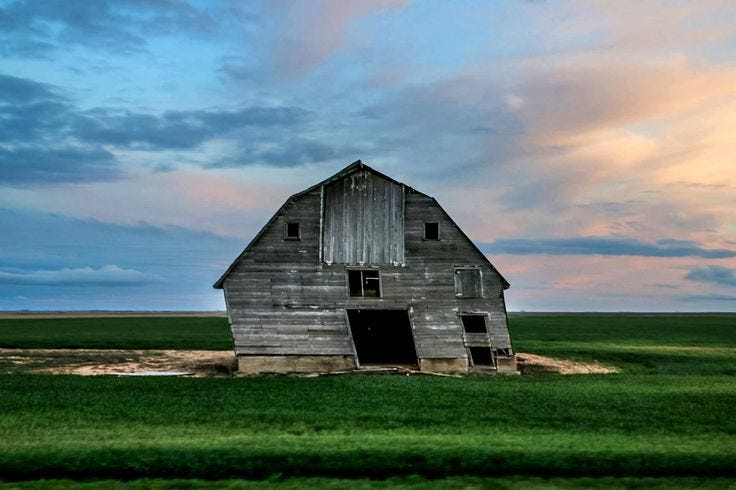
Watch a barn go up. The first day, every board you nail matters. The foundation, the sill plate, the corner posts: everything you do on day one holds everything that comes after. The structure is alive to itself. The man driving nails knows why he is driving them, knows the neighbor who will store hay in this barn, knows the particular wet of the winters here and how high the snow load gets. The building resonates with the place and the people. It nearly holds itself together.
Now watch what happens thirty years later when the county requires a permit for every modification, the state requires an inspector who has never seen a barn from the inside, the federal agency has a form for the drainage easement, and three different environmental consultants have submitted reports that contradict each other. The building is still standing. But what is holding it up is no longer the understanding of the people who use it. What is holding it up is enforcement. Somebody has to make sure all those rules get followed, because nobody believes in them the way the original builders believed in the barn.
That ratio: how much genuine agreement you have, versus how much enforcement you need. That’s the health of any human system. A barn built by neighbors who trust each other needs almost no enforcement. A barn built by committees needs inspectors for the inspectors.
Here is the thing to understand about technology. A mortise and tenon is a technology. So is a building code. So is a zoning ordinance. So is a regulatory agency. So is a constitution. These are all tools that let you build bigger than you could build before: more square footage, more stories, a bigger footprint than any one man and his neighbors could have managed with timber and hand tools alone.
The same is true in the life of faith. Creeds are a technology. Canon law is a technology. Denominational structure is a technology. They allowed the community of faith to grow beyond what a single congregation could hold, to coordinate across distances, to preserve teaching across generations. Nobody invented these things out of malice. They invented them because the barn kept needing to be bigger.
But every technology has a limit it cannot see from the inside.
The lag bolt can only carry so much load before the wood around it gives way or it sheers off. The regulatory code can only add so many requirements before the thing being regulated disappears under the weight of the requirements. The creed can only multiply so many clauses before the living faith it was meant to protect gets buried under rigid precision. At a certain point the technology is no longer serving the barn. The barn is serving the technology. And the men inside it have forgotten which was supposed to come first.
Jesus said it plainly, and He said it twice, in case we missed it the first time.
No one sews a piece of unshrunk cloth on an old garment. If he does, the patch tears away from it, the new from the old, and a worse tear is made. And no one puts new wine into old wineskins. If he does, the wine will burst the skins; and the wine is destroyed, and so are the skins. But new wine is for fresh wineskins. (Mark 2:21–22, ESV)
The wineskin is a technology. The old garment is a technology. He is not saying technology is evil. He is saying technology has a carrying capacity. Past that capacity, the patch tears. The skin bursts. What you were trying to preserve gets lost in the wreckage of the container.
If a kingdom is divided against itself, that kingdom cannot stand. And if a house is divided against itself, that house will not be able to stand. (Mark 3:24–25, ESV)
Now look around.
The progressive technocratic state has been adding boards for a century. Every identified problem generates a new agency, a new regulation, a new enforcement mechanism. The Federal Register, which is the official record of federal rules, ran to about two thousand pages in the 1930s. It ran to nearly a hundred thousand pages by the time most of us were paying attention. That is not a barn anymore. That is a structure so tall and so complicated that the people inside it cannot explain it to the people outside it, and the people outside it cannot find their way through it, and nobody—nobody—loves it. It is held up entirely by the cost of not complying.
That is a barn that is going to come down.
And the tragedy is that some of what was built into those walls was genuinely worth keeping. Life, liberty, and the pursuit of happiness. Those words are not the words of a committee. Those words are God-breathed: the image of God in man insisting that something real is at stake, that the creature who bears that image is not to be owned or managed or disposed of by the powerful. We hold these truths to be self-evident; self-evident because they are written into the nature of things, not invented by a legislature.
There are echoes in scripture. Where the Spirit of the Lord is, there is freedom (2 Corinthians 3:17). It is for freedom that Christ has set us free (Galatians 5:1). The dignity of the person, the sanctity of conscience, the limits of earthly power over the creature who answers finally to God; these are not progressive ideas or conservative ideas. They are old ideas, older than the Republic, deeper than any constitution. The founders touched something real. The barn they designed was not meant to reach the sky. It was meant to be serviceable. To hold the hay. To give the cattle shelter.
But we kept adding boards.
Here is what pride does to a man who has been climbing.
He does not come down. That is the one thing pride will not permit. Instead he adds another board. More regulations, more enforcement, more bureaucratic load. He mistakes the accumulation for the substance. He has been climbing so long he has forgotten that the point was never the altitude. The point was the barn. The point was the hay, the cattle, the neighbors, the winter.
If I cannot have this at the altitude I have claimed, I will take you down with me.
That is what suicidal looks like from the outside. The technocrat who would rather watch the republic burn than admit the barn got too tall. The politician who would rather torch the institution than lose the argument. They are not villains by nature. They are men and women who climbed too high and cannot face the ground. The only move left to pride, when the structure is swaying, is to make sure that if it falls, it falls on someone else.
Now here is where the Christian has to say the hard thing.
We are not immune.
The same pride can enter any institution; including the ones we love. The denominational executive who would rather litigate to save face rather than to own up. It is not a theological condition. It is a human one, as old as the first man who decided the fence he built to protect the garden was more important than the garden. Any community of faith that has spent generations adding enforcement structures—bodies to police doctrine, bureaucracies to manage belonging, distant authorities to adjudicate what the local congregation could settle for itself—has entered the same condition as the regulatory agency. The enforcement has outrun the agreement. The institution is being held up by rules that nobody loves. And you can tell, if you are honest, the same way you can tell a failing farm: by whether the people are there because they want to be, or because leaving would cost them something.
Voluntary presence is the sign of genuine health. Coerced presence is the sign of a structure being held up by force.
But here is what pride cannot touch.
The ground.
The barn at Babel came down. It always comes down. Rome came down. The Soviet Union came down. Not slowly, not gracefully, the way a barn comes down in a windstorm: all at once, and then there is just the field. The people went back to the village, back to the family, back to the fifty people who knew each other’s names. Not because they chose it philosophically. Because that is what actually holds. That is the ground that was always there, patient underneath all the altitude.
And on that ground, only certain things remain.
Not the regulatory code. Not the denominational directory. Not the policy framework or the enforcement mechanism or the ideological program. Definitely not the QR code. Those are all technologies, and technologies reach their limit and fail.
What remains is what was never a technology to begin with.
“And now these three remain: faith, hope, and love. But the greatest of these is love.” (1 Corinthians 13:13)
Faith is beyond creed. Hope is not a program. Love is not an enforcement mechanism. You cannot write them into a regulatory code. You cannot put them in a filing cabinet. They do not require an inspector. They are not the product of a committee. They are the ground itself; the fixed point that the barn was always supposed to serve, the thing that holds when everything built by the hands and pride of men has swayed and fallen and gone quiet.
We are, I think, close to a moment when the adults return to the house and say: Enough of this. Stop the nonsense.
What they will find depends on what we have kept. Not the altitude. Not the structure. Whether the local knowledge is still alive. Whether the neighbor still knows how to build the barn. Whether the family still knows what it is for. Whether the congregation can recognize each other’s faces without a text-group or directory to tell them who belongs.
That is the work. Not the ideological counter-argument. Not the political campaign. The work is keeping the ground-level things alive; the marriage, the garden, the local church that knows its people, the county meeting where someone still stands up and says what they actually think; while the high-altitude structures go through whatever they are going to go through.
The farmer does not grieve the falling barn. He was never confused about what the barn was for.
He saves the seed. He minds the soil. He is still here when the swaying stops and the field is quiet again.
You make things runinate in my head David. Thank you.