The Deeper Constitution
Why Administrative States Fail at the Boundary of Biological Reality, and What Happens When They Do

Preface
The cashier at Swain’s General Store and I had a brief interaction a few days ago. I paid in cash and remarked, “I like paying in cash.”
She replied, “Yep, cash is here to stay. That’s all some people have.”
She was not making a philosophical argument. She was describing people, and in rural America, a low end estimate would be around 5-15%, who can only ever pay in cash. She was describing the retired logger in Joyce whose hands shake badly enough that a touchscreen is a daily humiliation. Or the veteran in Port Angeles managing a traumatic brain injury who loses track of passwords and account numbers the way the rest of us lose track of dreams. The seasonal worker whose income arrives in cash and whose financial life is conducted entirely outside the systems that planners in distant offices assume everyone uses.
These are not edge cases. They are the population. In a county where the median age runs older than the state average, where disability rates exceed national norms, where the cash economy of fishing and timber and small farming has always run alongside the official one, the cashier at Swain’s knows something that a lot of policy architects do not: you cannot fully administer the people in front of you. The gap between what the system requires and what people can actually do is permanent, and it is not a problem that better technology will solve.
From that gap, which seems like a minor administrative inconvenience, follows a cascade of consequences that reach all the way to the structure of civilization, the logic of totalitarianism, and the question of what a constitution is actually made of. The theorem that results, let’s call the Deeper Constitution Theorem, is a claim about the permanent ceiling on state administrative capacity, derived not from political preference but from the structure of human biology, the mathematics of complexity, and the sociology of institutional design.
Definitions
Two kinds of memory structure a society: not memory in the private psychological sense, but the accumulated store of what a people knows, practices, believes, and transmits. The relationship between them determines almost everything about whether it holds together.
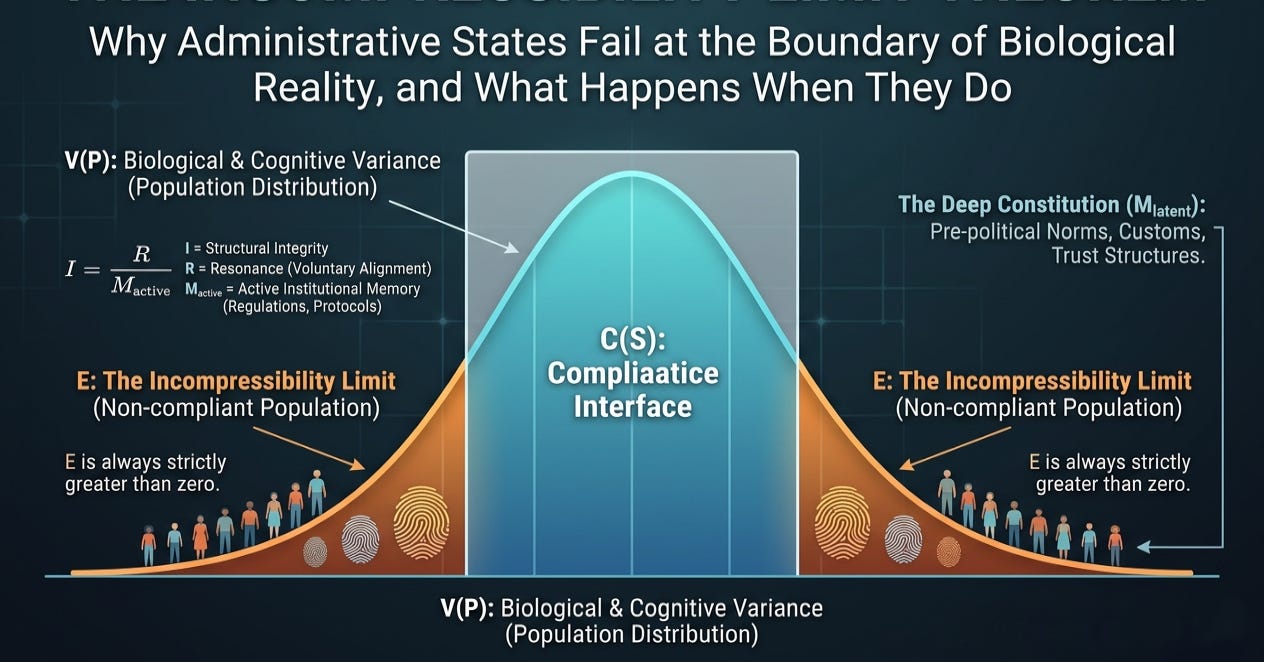
The first is Active Memory, M_active. This is everything a society explicitly administers: every enacted law, every published regulation, every agency mandate, every credentialing requirement, every enforcement procedure. M_active is the written, staffed, budgeted layer of social organization. It does not maintain itself. It requires continuous energy, attention, and money to sustain. When the energy stops, M_active decays: regulations go unenforced, agencies hollow out, laws stay on the books but lose operative meaning. Every item in the Federal Register, which ran to 2,620 pages in 1936 and 95,894 pages by 2016 (Crews 2017), is M_active. Every new rule adds to the load the system must carry. Every line on a roadway must be repainted.
The second is Latent Memory, M_latent. This is everything a society does not need to administer because it is already inside the people: the norms, customs, kinship structures, local knowledge, religious frameworks, and moral intuitions that operate without a budget line or an enforcement mechanism. A community with a strong norm against theft does not need a police officer on every corner. The norm is carried inside the people themselves. M_latent is transmitted the way things have always been transmitted in places like Clallam County: through family, through church, through the knowledge passed between a fisherman and his son about how to deal honestly, through the unspoken rules of a crew about what you owe the man working next to you. It is the deep grammar of social life. People follow it without being told to, often without being able to say they are following rules at all.
John Adams put this plainly when he wrote that the Constitution was made only for a moral and religious people (Adams 1798). He was not making a narrow religious argument. He was making a structural one: the written document, M_active, can only function if the unwritten substrate, M_latent, is dense enough to sustain voluntary compliance. Without M_latent, M_active must be enforced entirely by coercion, which is expensive, ultimately insufficient, and corrosive to the legitimacy it depends on. You cannot write enough rules to replace a people who have stopped believing that the rules are worth following.
Resonance (R) is the degree of genuine voluntary alignment between the population and the institutional structure. The practical question R answers is simple: are people complying because they believe the system is legitimate, or because they fear what happens if they do not? High R looks like the longtime Clallam County resident who files an honest tax return because she thinks that is what a decent person does. Low R looks like the same return filed honestly only because the audit probability is high enough to make cheating unwise. The behavior looks identical from the outside. The structural meaning is entirely different. R is not directly measurable but has reliable behavioral proxies: voluntary tax compliance rates, military volunteerism, jury service compliance, and the ratio of informal to formal economic activity. When R falls, enforcement costs must rise to compensate, because the work that voluntary compliance was doing must now be done by apparatus.
Structural Integrity (I) is defined as:
It measures genuine social coherence relative to institutional load. A society with high I has strong voluntary alignment and relatively light administrative machinery. A society with low I has heavy machinery and thin alignment, doing most of its work through enforcement rather than consent. As M_active grows and R stagnates or falls, I approaches zero. This is not chaos. It is hollow coherence: a structure that looks operational from the outside but is increasingly dependent on energy injection to maintain the appearance of function. The shell stands. The load-bearing material is gone.
Biological variance is the irreducible width of the distribution of human cognitive, physical, and behavioral capacity. People in my county, like people everywhere, vary enormously in working memory, executive function, sensory and motor capability, emotional regulation, and the dozens of other dimensions that bear directly on their ability to comply with standardized administrative systems. This variance is not a temporary condition. It is a structural feature of the species, maintained by evolutionary pressure because wide variance is a survival strategy at the population level. A narrow distribution is efficient in stable conditions and catastrophically fragile when conditions shift. Evolution does not optimize for efficiency. It optimizes for resilience. The variance is permanent, and it is, in a deep sense, the point.
Administrative closure is the condition in which a system achieves complete coverage: every person, every transaction, every behavior within the administrative perimeter, no exceptions, no informal pathways. It is the implicit goal of technocratic governance. It is also, as this theorem argues, a biological impossibility. The population always contains a permanent fraction for whom any given standardized compliance interface is operationally inaccessible, not because they are deficient but because the system was calibrated for a narrower distribution than the species exhibits. The cashier at Swain’s knows this. The people designing cashless payment systems, on the whole, do not.
An exception pathway is any mechanism by which people who cannot meet the standard compliance interface are served within the system or alongside it: paper money next to digital payment, an in-person window next to an online portal. Exception pathways are not failures of system design. They are acknowledgments that administrative closure is impossible. Every exception pathway is an implicit concession that irreducible variance exists and must be accommodated rather than eliminated.
The firewall refers to the pre-political moral frameworks carried in M_latent that establish categorical limits on what administrative logic is permitted to do to human beings, regardless of the efficiency gains that might result from ignoring those limits. The concept of imago dei in the Abrahamic traditions is the clearest historical example: every human being possesses inherent dignity that cannot be reduced to their utility or their compliance. This is a firewall because it is categorical and pre-theoretical. It does not permit a cost-benefit analysis of whether a particular person is worth accommodating. The person is worth accommodating because they are a person. The question of whether it would be more efficient not to accommodate them does not arise, because the framework within which that question would be asked has been foreclosed. Secular traditions have developed analogous firewalls in concepts like inalienable rights and human dignity. These are real and valuable. But they are structurally weaker than their religious sources because secular philosophy has no mechanism for ruling certain questions permanently out of bounds. A utilitarian can always construct a scenario in which the calculation favors elimination. A theologian working within the imago dei tradition cannot. It is the firewall, and the durability of the communities that carry it, that provides the deep optimism underlying this analysis.
The deeper constitution is M_latent considered as the actual operative constitution of a society: the pre-political norms, moral intuitions, cultural practices, and trust structures that determine how people actually behave. The shadow constitution is what we normally call the constitution: the written document, the enacted law, the official charter. The shadow constitution is a shadow in the precise sense that it is a projection of the deep constitution onto paper. It functions only to the extent that the deep constitution it projects is real and dense. A society with dense M_latent can operate under almost any shadow constitution, because the operative rules are carried inside the people. A society with depleted M_latent will fail under even the best-designed shadow constitution, because the written rules have no substrate to run on.
The cashier at Swain’s who knows that cash is here to stay because that is all some people have is operating from a dense local M_latent. She knows her county. She knows who asks for popcorn. No planner with a model told her that. The knowledge is inside her because she lives here, among these people, in this place. That knowledge, multiplied across a community, across generations, is what a deep constitution is made of.
The incompressibility ceiling is the hard limit that knowledge points to. Every administrative system, no matter how well designed or generously funded, eventually meets the fraction of the population it cannot serve, not because the system failed, but because the population is irreducibly wider than any standardized compliance interface can reach. You can move the ceiling up with more resources and better design. You cannot eliminate it. The species is too varied. The cashier knows this. The planner, characteristically, does not, because the planner is working from a model of the population rather than from the population itself. The ceiling is not a design problem. It is a biological fact, and the theorem is built within it.
Three Ceiling Probes
These cases are not extreme. They are ordinary. That is the point.
Case A is the digital payment system. Require all transactions to be digital and you immediately face the population that cannot comply: the cognitively impaired, amputees whose fingerprints are absent, people in psychiatric crisis, the homeless, the elderly in decline, children, anyone in a rural county where the network doesn’t reach. Each group needs an exception pathway. Each exception pathway needs its own administrative apparatus to determine who qualifies. Each apparatus generates edge cases requiring adjudication. The result is a large bureaucracy managing exceptions to the main system, running alongside the main system, increasing M_active without increasing R. The only stable resolution is to keep paper money permanently. But keeping paper money permanently means admitting administrative closure is impossible. That admission falsifies the premise.
Case B is mental health and addiction. The DSM has grown from 106 diagnoses in 1952 to over 300 today, not because new diseases appeared but because administration requires categories that biology does not provide. Every new category pulls more of what community and family once managed into the administered system, while reducing the capacity of community and family to function. Addiction recovery depends on belonging, meaning, and personal accountability, properties of M_latent that cannot be manufactured by M_active. You cannot administer belonging. The system depletes the substrate that produces mental health, generates the disorder load it must then treat, and depletes the substrate further in the treating. That is not a policy failure. It is the architecture.
Case C is the family. Babies cannot be administered. Reproduction cannot be optimized at the family level without destroying the family. A baby requires continuous, relationally specific care from a small number of consistent adults. This is biological specification, not cultural preference. No institution can replicate it at scale because staffing ratios and shift schedules are structurally incompatible with what an infant actually needs. The family is where M_latent is transmitted. Compete with it and you win by destroying the thing you needed in order to function.
The Deeper Constitution Theorem
The name requires a word of explanation. C.S. Lewis, in The Lion, the Witch and the Wardrobe, gives us the White Witch who knows the Deep Magic: the law written on the Stone Table that says Edmund’s life is forfeit. She is right. The law is real. But Aslan knows something older: the Deeper Magic, written before the dawn of time, which the Witch did not know because her wisdom did not go back far enough. When a willing victim who has committed no treachery is killed in a traitor’s place, the Stone Table cracks and death works backward.
That is the structure of the argument here. The shadow constitution—the written law, the regulatory code, the administrative charter—is the surface-level magic: real, operative, consequential. But underneath it is something older that the administrative mind does not know, because its wisdom does not go back far enough: the pre-political moral fabric of the people, the norms and trust and kinship and belief that were there before the law was written and will be there, in some form, after the law has crumbled. That is the Deeper Constitution. The theorem is about what happens when you try to govern without knowing it is there.
Now the formal statement.
Call the administrative system S. It is trying to achieve what the theorem calls operational closure: full coverage, no exceptions, every person and transaction inside the perimeter. Call the population it serves P. P is biologically diverse in ways that are permanent and irreducible: the distribution of cognitive capacity, physical ability, emotional regulation, and functional independence across any real human population is wide, and evolution made it that way on purpose. Wide variance is how a species survives conditions it cannot predict.
Call the fraction of P that cannot meet the system’s compliance requirements E, the exceptions. The first thing the theorem says is that E is always greater than zero. You cannot simultaneously standardize a compliance interface, which is what administration requires, and make it accessible to a population whose biological variance is irreducible. The math is simple: standardization compresses the interface toward a point; biological variance keeps the population spread wide. The gap between them does not close. E is always positive. There is always someone the system cannot reach.
The second thing the theorem says is that S faces exactly two exits when it confronts people who are exceptions (E).
Exit One: keep the exception pathways permanently. Retain paper money alongside the digital system. Keep the in-person window open. Acknowledge that closure is impossible and build a system that accommodates rather than eliminates variance. This is the honest path. Its cost is admitting that the premise was wrong, that you cannot fully administer a biologically diverse population.
Exit Two: redefine E as a problem to be solved rather than a population to be served. Reclassify the people who cannot comply as errors in the system rather than evidence of the system’s limits. Then correct the errors, through compulsory intervention, institutionalization, or removal. This preserves the closure premise. It does so by reducing the population until the remaining population fits the compliance interface. The system does not fail. The people are the bugs in the code.
The third thing the theorem says is that which exit a system takes is not determined by its ideology. It is determined by the density of M_latent, specifically by the firewall structures carried in the deeper constitution. Where the community is intact, where the family is present, where the church or the local web of mutual obligation still functions, Exit Two is practically unavailable. Not because it is illegal, but because the people around the non-compliant person will not permit it. The neighbor, the pastor, the tribal member, the family. They impose what no law can impose: the pre-theoretical refusal to treat a person as a system error. That refusal does not come from policy. It comes from something written, as Lewis would say, before the dawn of time.
Where that web is gone, Exit Two becomes thinkable. And the theorem’s fourth and hardest proposition is this: the progressive technocratic system is structurally committed to depleting the very M_latent that keeps Exit Two unavailable. It pursues administrative closure, which forces the choice. And it dismantles the community, family, and religious structures that would foreclose Exit Two before the choice could be made.
That is not an accusation of intent. It is a description of architecture.
The Firewall in Detail
The firewall is not a law. Laws are M_active. Laws get repealed, reinterpreted, or quietly ignored when the political will to enforce them runs out. The firewall is something else. It is the pre-theoretical conviction, carried inside the people themselves, that certain things cannot be done to a human being regardless of what the administrative logic recommends. Lewis calls it the Deeper Magic. It is older than the statute. It does not require a budget line.
The clearest example is the concept of imago dei. The person who cannot manage a digital interface, the mother who cut up her credit card, the veteran with a traumatic brain injury who forgets his passcodes, none of them need to justify their existence to the system. The framework halts the question before it can be asked. That is what a firewall does. It does not argue against Exit Two. It makes Exit Two unthinkable.
Secular equivalents exist—inalienable rights, post-World War Two human rights law—and they are real and valuable, but weaker. The reason is not sentimental, as we all learned first-hand during covid. A utilitarian philosopher can always construct a scenario in which the calculation favors eliminating a dependent population. A theologian working within imago dei cannot, because the tradition has ruled that calculation permanently out of bounds. Secular philosophy is, in significant part, a commentary on a moral tradition. When the tradition erodes, the commentary loses its footing.
The twentieth century is the evidence. Eugenics was endorsed by the leading progressive institutions of its time: the American Medical Association, major universities, prominent intellectuals including H.G. Wells, George Bernard Shaw, and Margaret Sanger (Kevles 1985). It was resisted most effectively by Catholic and other religious institutions operating from theological anthropology. The Nazi T4 program, the systematic killing of disabled people, was designed and administered by credentialed physicians and social workers (Lifton 1986). The resistance came from religious communities. The secular institutional structure largely accommodated the program once it was legally established.
That is not an argument for theocracy. It is an argument for understanding what the Deeper Constitution is made of and what happens when it thins. In Clallam County the web still holds. Families are somewhat intact. The tribal communities along the Strait are active and connected. The churches are growing. That is not nothing. That is the firewall. Not because of a law. Because of something older: the knowledge, carried in the people, that the man who cannot work the interface is still the man, and you know his name, and you are not going to let the system define him as an error.
The firewall is load-bearing. And it does not maintain itself through administration. It maintains itself through exactly the kind of community life that the administrative state, in its pursuit of closure, persistently undermines.
Shadow vs Deeper
Political science spends most of its time on the shadow constitution: the written document, the enacted charter, the formal legal structure. This is understandable. The shadow constitution is visible. You can read it, cite it, argue about it in court. But focusing on it exclusively produces a systematic misunderstanding of how societies actually hold together and why they fall apart.
The Deeper Constitution is M_latent considered as operative social structure: the norms, the trust relationships, the moral intuitions, the cultural practices that determine how people actually behave when the formal system makes demands on them. It is what Adams meant. It is what Tocqueville saw when he came to America and concluded that the secret of the thing was not in the laws but in the habits of the heart, the mores of the people (Tocqueville 1835). It is what Burke was defending against the French Revolutionaries: not that the inherited custom was perfect, but that it was load-bearing in ways that abstract rational principle could not replace, and you do not find that out until you tear it out and watch what happens (Burke 1790).
Lewis gives us the right image. The White Witch knew the Deep Magic: the written law, the Stone Table, the formal claim. What she did not know was that something older underwrote it and could crack it. The shadow constitution is the Stone Table. The Deeper Constitution is inherent. You cannot administer what is written beneath it into existence. (Just knowing that the Deeper exists allows me to be an optimist in these dark times.)
The shadow constitution is a projection of the Deeper Constitution onto paper. A bill of rights does not create the moral intuitions that make rights meaningful. It formalizes them, stabilizes them, gives people a place to stand when those intuitions come under pressure. That is valuable. But it cannot generate the substrate from scratch. The post-Soviet states learned this. They adopted Western constitutional forms in the 1990s and did not thereby acquire the civic culture, the institutional trust, or the voluntary compliance habits that make those forms function (Putnam 1993, Fukuyama 2011). They got the shadow, but applied to a largely eroded substrate.
The progressive technocratic project makes a characteristic error here. It treats the shadow constitution as primary and tries to use M_active to engineer the M_latent it needs. If the population does not have the right values, the system will construct them: through schools, media, incentive structures, legal apparatus. This is the logic of progressive education from Dewey forward: the school does not transmit an inheritance, it builds a new one (Dewey 1916). The assumption underneath all of it is that M_latent is a product of M_active, that you can administer your way to the cultural substrate you require.
The causation runs the other way. M_latent is produced by lived community, by family, by the intergenerational transmission of norms through intimate relationship and shared story and common worship. M_active can shape it at the margins over long time horizons. But the primary direction is M_latent determining which M_active is legitimate; determining which rules people will follow because they believe in them rather than because someone is watching.
When you run the causation backwards you do not get a new M_latent. You get more M_active piled onto a thinning substrate. I approaches zero. The structure looks operational. The load-bearing material is gone.
In Clallam County the Deeper Constitution is still legible. It is in the working families who know what they owe each other. It is in the tribal communities that have held their obligations across generations of pressure that would have dissolved a weaker web. It is in the churches where people still show up for one another without being administered to do so. That is not nostalgia. That is the thing itself, older than any charter, load-bearing in ways the shadow constitution can encode but cannot create.
You cannot design it. You cannot file a form for it. You can only cultivate it, transmit it, and refrain from dismantling it in the name of bringing it under control.
Exit Two as Revealed Logical End
During covid, administrative rules on vaccination required some government workers in our county to comply or be fired. Some who objected were classified as an error, a bug in the system, and fired. Someone else took the job. The rule was applied. The people were reclassified. But what if the next rule goes even further. The logic does not change. Only the stakes do.
This is the structure the Deeper Constitution Theorem is pointing at. The Nazi program cannot be treated here as a unique pathology or a deviation from normal governance. It is treated as the logical terminus of administrative closure pursued under conditions of depleted firewall. That framing is not comfortable. It is necessary.
The Nazi system was a technocratic project with full scientific legitimacy. Eugenics was mainstream academic science in the 1920s and 1930s, taught in universities across Europe and North America, endorsed by physicians, scientists, and social reformers (Kevles 1985). The American eugenics movement predated the Nazi program and provided significant intellectual resources to it. The United States Supreme Court endorsed compulsory sterilization of the cognitively disabled in Buck v. Bell (1927), in an opinion written by Oliver Wendell Holmes, a progressive legal icon, not a fascist, which concluded simply: three generations of imbeciles are enough. That was not an aberration. It was progressive science applied by a progressive jurist to a perceived social problem.
The T4 program, which organized the systematic murder of disabled and mentally ill individuals beginning in 1939, was administered by credentialed physicians, organized through standard bureaucratic procedures, and rationalized in the language of resource allocation. The term useless eaters was not hate speech. It was administrative classification, a category describing individuals who consumed resources without contributing productive output. The physicians who signed the death orders were not sadists. They were professionals applying the logic of administrative closure to the incompressibility problem: what do you do with the fraction of the population that cannot, or even will not, comply with the system’s requirements?
The T4 program gave the answer Exit Two has always given. Redefine variance as pathology. Redefine pathology as a problem to be eliminated rather than accommodated. Then eliminate it.
The question the theorem raises is not whether this was evil. It was. The question is what made it thinkable. The answer is depleted firewall. The religious institutions that had historically carried the categorical prohibition—this person is made in the image of God and cannot be classified as a system error—had been substantially weakened in Germany by a century of progressive and nationalist intellectual culture that treated religious moral reasoning as superstition. The secular institutions had no equivalent categorical claim. Medicine, law, and the universities had utilitarian and scientific frameworks that were, in principle, open to the calculation that some lives were not worth sustaining. Once the framework permits the calculation, the calculation will eventually be made.
The resistance that did occur came from religious institutions, specifically from Catholic bishops who preached against T4 publicly. That resistance was effective enough that the official program was suspended in 1941, though the killing continued by other means (Burleigh 1994). The secular institutional structure offered no comparable resistance. It accommodated the program once it was legally established.
The lesson is not that religion is always right. The lesson is that the firewall is load-bearing and M_latent is its carrier. And the path from firing the employee who won’t apply Rule A to signing the death order is not a leap. It is a series of small, administratively coherent steps, each one following from the last, in a system that has lost the thing that would have made the first step unthinkable. That knowledge which is pre-theoretical, pre-legislative, and older than any charter is what stands between Exit One and Exit Two. It does not come from administration. It cannot be administered into existence. It can only be protected, or depleted.
Where We Are
The present progressive technocratic state has not chosen Exit Two the way the Nazi system did: explicitly, programmatically, with death orders signed by physicians. But the theorem is not about intentions. It is about conditions. And the conditions it identifies as precursors to Exit Two availability are present, measurable, and palpable.
Lewis saw it coming. That Hideous Strength, written in 1945, describes the N.I.C.E., the National Institute of Coordinated Experiments, a bureaucratic institution that arrives in an English village with scientific legitimacy, progressive credentials, and the quiet assumption that the old ways of living must be cleared away to make room for rational administration. It does not announce its intentions. It issues memoranda. It acquires property. It builds apparatus. The horror of the book is not that the N.I.C.E. is obviously evil. It is that it is so thoroughly ordinary, so fluent in the language of improvement and efficiency and expert management, right up until it isn’t.
That is the structure of the concern here.
Across the second half of the twentieth century, the dense network of voluntary associations that constituted American civil society collapsed: fraternal organizations, religious participation, neighborhood associations, the ten thousand informal arrangements through which people once held each other accountable and kept each other alive (Putnam 2000). Jean Twenge and colleagues found the consequences in the generation that grew up without it: sharply rising loneliness, depression, and anxiety that reflect not just individual suffering but the depletion of the relational substrate that M_latent requires to reproduce itself (Twenge 2017). The trust data from Pew, Gallup, and the General Social Survey show something more alarming than declining institutional trust: interpersonal trust is falling simultaneously. That is the signal that M_latent itself is thinning, not merely being routed around.
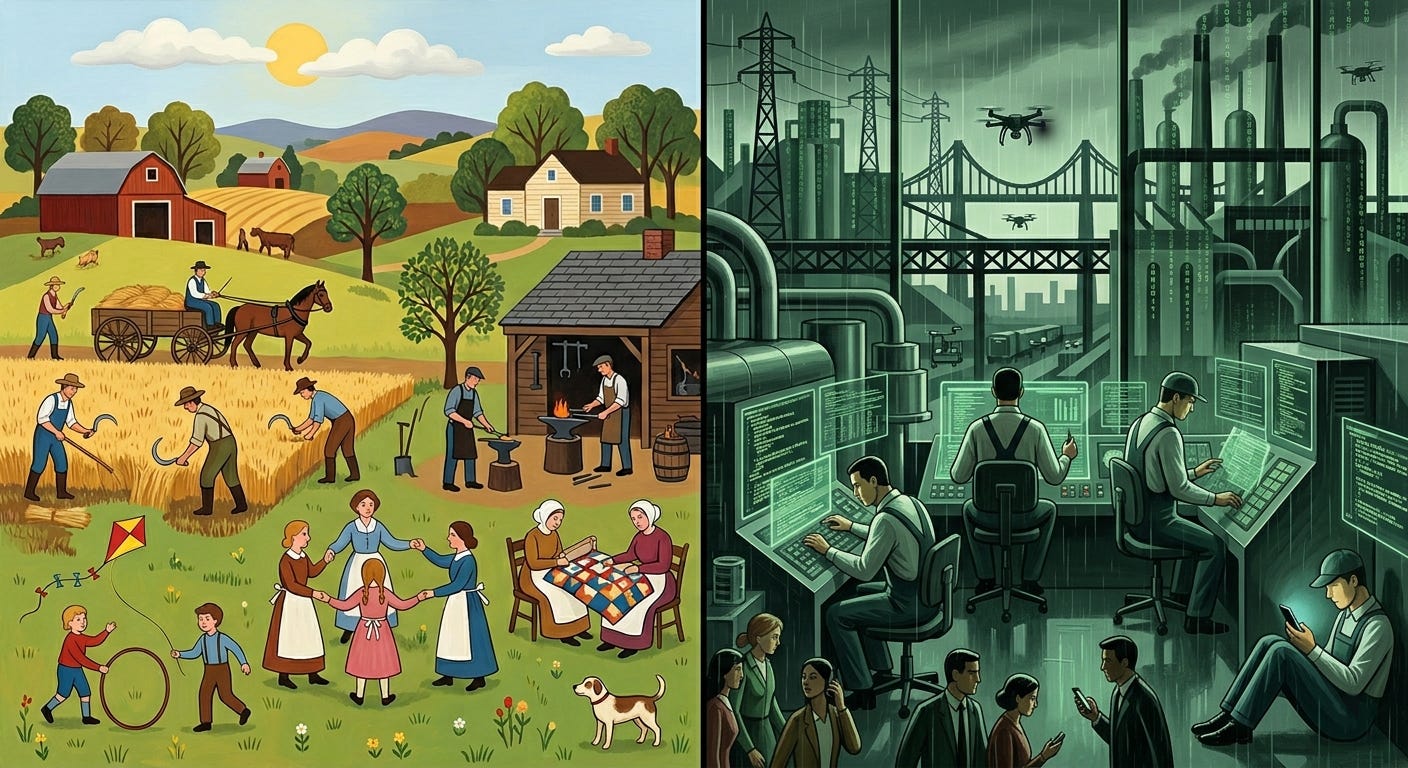
The farm family that once managed its own food, its own labor, its own grief, and its own celebration has been replaced by administered alternatives for each of those functions: the grocery supply chain, the labor market, the clinical mental health system, the event venue. Each replacement is more efficient in the narrow sense. Each one removes another strand from the web. The firewall web does not announce when it has become too thin to hold. It just fails, and then people wonder why.
Religious reasoning has been systematically marginalized from public discourse, treated as private preference rather than moral knowledge. Traditional family structure has been delegitimized, not by argument exactly, but by the cumulative pressure of incentive structures that make it harder to form and easier to dissolve. Community-based mental health and social support have been replaced by administered clinical alternatives that treat the symptom while depleting the substrate that would have prevented it. None of the people doing these things experience themselves as eroding a firewall. They experience themselves as expanding inclusion, advancing science, reducing stigma, and harm reduction. The structural effect is the same regardless of the experience.
The contemporary debates about abortion, euthanasia for psychiatric conditions, and the rationing of care for severe disability in resource-constrained systems all contain, in early form, the reasoning structure that T4 made explicit. The question is not whether the people in those debates are Nazi-adjacent. They are not. The question is whether the firewall is dense enough to hold as the administrative pressure increases and the utilitarian calculation becomes more available and more respectable.
The N.I.C.E. did not begin by killing anyone. It began by being reasonable. It began by having the right credentials and the right intentions and the right language for every objection raised against it. The people of the village could not articulate what was wrong because what was wrong was not yet visible in any single action. It was visible only in the pattern: in what was being quietly cleared away to make room for the new order.
The theorem says the pattern is what to watch. Not the stated intentions. Not the individual policy. The pattern of what is being cleared away, and whether what remains is dense enough to hold when the fork is reached.
The Swain’s Cashier was Right
The Deeper Constitution Theorem is not a conservative argument in the partisan sense. It is a structural argument. It says something about what holds a society together and what happens when that thing is mistaken for an obstacle.
The implication is not that we should have no government, no law, no policy response to real problems. It is that any administrative system that ignores the incompressibility ceiling will eventually be forced to choose between Exit One and Exit Two. Systems designed around the ceiling—federalism, subsidiarity, local governance, common law built from precedent rather than statutory command—are not conservative preferences in the tribal sense. They are architectural choices that respect what the population actually is rather than what the system requires it to be.
Wendell Berry wrote in The Unforeseen Wilderness (1971) that "the life of a man who knows that the world is not given by his fathers, but borrowed from his children; who has undertaken to cherish it and do it no damage, not because he is duty-bound, but because he loves the world and loves his children." We must tend what we have borrowed. The farm, the family, the neighborhood, the congregation. Not because these things are perfect but because they are real, and because the knowledge carried in them, the knowledge of who your neighbor is and what you owe him, is the kind of knowledge that cannot be recovered once it is gone. It is not produced by administration. It is produced by living together over time, which is a thing that cannot be accelerated or outsourced or optimized.
The Deeper Constitution is that knowledge, accumulated and transmitted across generations, carried inside the people rather than encoded in the statute. The shadow constitution—the written law, the formal charter—is its projection onto paper. Valuable, but secondary. The projection cannot generate the source. You can try to redesign the Stone Table, but what is written beneath it does not change, and it does not appear on demand.
The task of politics, properly understood, is not to extend administrative closure. It is to protect and transmit the firewall. To keep the web intact. To resist the institutional creep that treats every domain of life not yet administered as a problem to be solved.
The cashier at Swain’s knew cash was “all some people have.” She was not making a policy argument. She was speaking from the Deeper Constitution, from the knowledge, carried inside her from living here among her people, that the system must fit the person and not the other way around. She knew the incompressibility ceiling the way a farmer knows the frost date: not from a theory, but from watching what happens when you ignore it.
Full paper: The Deeper Constitution: Latent Memory Dynamics in Socio-Political Fabric
References
Adams, John. Letter to the Massachusetts Militia. October 11, 1798.
Ainsworth, Mary D. Salter, et al. Patterns of Attachment: A Psychological Study of the Strange Situation. Lawrence Erlbaum, 1978.
Alcoholics Anonymous World Services. Alcoholics Anonymous 2014 Membership Survey. AA World Services, 2014.
American Psychiatric Association. Diagnostic and Statistical Manual of Mental Disorders, Fifth Edition, Text Revision (DSM-5-TR). APA, 2022.
Bank for International Settlements. Central Bank Digital Currencies: Foundational Principles and Core Features. BIS, 2021.
Bowlby, John. Attachment and Loss, Volume 1: Attachment. Basic Books, 1969.
Bronfenbrenner, Urie. Two Worlds of Childhood: U.S. and U.S.S.R. Russell Sage Foundation, 1970.
Buck v. Bell. 274 U.S. 200. United States Supreme Court, 1927.
Buolamwini, Joy, and Timnit Gebru. Gender Shades: Intersectional Accuracy Disparities in Commercial Gender Classification. Proceedings of Machine Learning Research, 2018.
Burke, Edmund. Reflections on the Revolution in France. 1790.
Burleigh, Michael. Death and Deliverance: Euthanasia in Germany 1900-1945. Cambridge University Press, 1994.
Chesterton, G.K. Heretics. John Lane, 1905.
Crews, Clyde Wayne. Ten Thousand Commandments: An Annual Snapshot of the Federal Regulatory State. Competitive Enterprise Institute, 2017.
Damasio, Antonio. Descartes’ Error: Emotion, Reason, and the Human Brain. Putnam, 1994.
Dewey, John. Democracy and Education. Macmillan, 1916.
Fukuyama, Francis. The Origins of Political Order. Farrar, Straus and Giroux, 2011.
Hayek, Friedrich. The Use of Knowledge in Society. American Economic Review 35:4, 1945.
Hennessy, Alistair. The Haitian Revolution and Its Effects. In The Cambridge History of Latin America. Cambridge University Press, 1999.
Kant, Immanuel. Groundwork of the Metaphysics of Morals. 1785.
Kelly, John F., and Julie D. Yeterian. Mutual-Help Groups for Alcohol and Other Substance Use Disorders. In Clinical Handbook of Co-Existing Mental Health and Drug and Alcohol Problems. Routledge, 2012.
Kevles, Daniel J. In the Name of Eugenics: Genetics and the Uses of Human Heredity. Knopf, 1985.
Lagarde, Christine. An Even-Handed Approach to Crypto-Assets. International Monetary Fund Blog, 2020.
Lifton, Robert Jay. The Nazi Doctors: Medical Killing and the Psychology of Genocide. Basic Books, 1986.
Putnam, Robert D. Making Democracy Work: Civic Traditions in Modern Italy. Princeton University Press, 1993.
Putnam, Robert D. Bowling Alone: The Collapse and Revival of American Community. Simon and Schuster, 2000.
Schore, Allan N. Effects of a Secure Attachment Relationship on Right Brain Development, Affect Regulation, and Infant Mental Health. Infant Mental Health Journal 22:1-2, 2001.
Tainter, Joseph. The Collapse of Complex Societies. Cambridge University Press, 1988.
Tocqueville, Alexis de. Democracy in America. 1835.
Twenge, Jean M., et al. Increases in Depressive Symptoms, Suicide-Related Outcomes, and Suicide Rates Among U.S. Adolescents After 2010 and Links to Increased New Media Screen Time. Clinical Psychological Science 6:1, 2017.
Van der Kolk, Bessel. The Body Keeps the Score: Brain, Mind, and Body in the Healing of Trauma. Viking, 2014.
Varela, Francisco J., Evan Thompson, and Eleanor Rosch. The Embodied Mind: Cognitive Science and Human Experience. MIT Press, 1991.
Zelenka, David D. Fabric-Operational Geometry Framework: Market Dynamics as Coherence Threading. 2026a.
Zelenka, David D. Fabric-Operational Geometry Sociopolitical Dynamics: Attractor Setting as Constitutional Design. 2026b.
Zelenka, David D. Fundamental Limits of Artificial General Intelligence: A Synthesis of Computational Complexity, Embodied Cognition, and Thermodynamic Constraints. 2026c.
Zelenka, David D. Intrinsic Operational Gradient Theorem: Foundation. 2025a.
Zelenka, David D. The Threaded Mind: Consciousness as Recursive Memory Dynamics. 2025b.