Climate Apocalypse Now?
On oceans, skies, carbon footprints and their priests

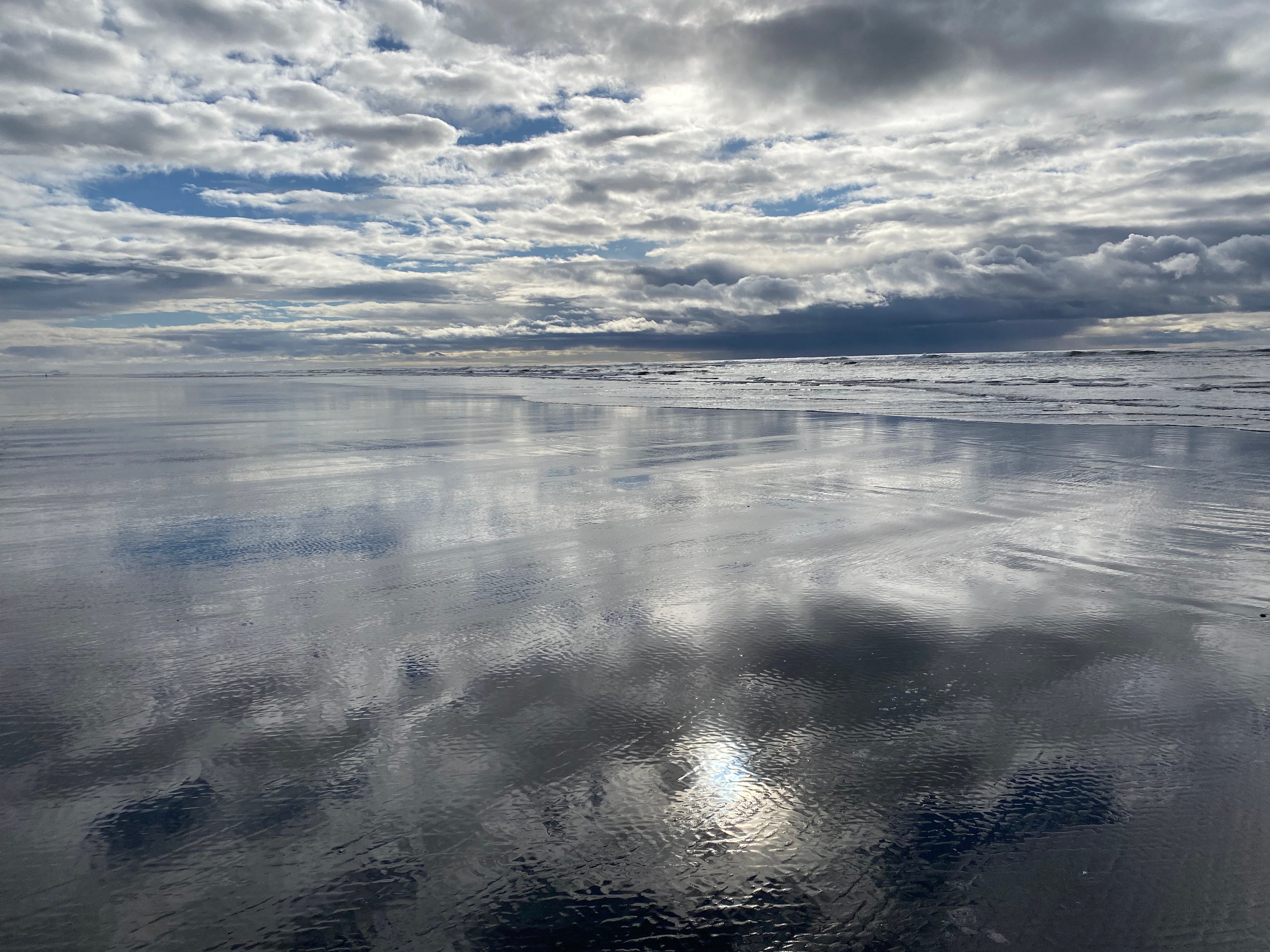
I worked on a climate change project for about fifteen years—part time. Education and outreach, federally funded. In the early years, the working narrative was honest enough: climate has always changed. But around 2008, something shifted in the room. I wasn’t part of leadership, just a hired hand, but I remember asking, after the whole IPCC hockey-stick mess became public, “Aren’t we going to shift away from this focus a little?” The answer came back, deeply caring: “Oh, no.”
Here locally, every summer after a low-snow winter, the same line gets dusted off: but most of our glaciers are gone now. And the reasonable, common-sense reply is that they’ve been receding since the Little Ice Age broke in the 1850s, a century before industrial CO2 had any measurable footprint, and long before anyone could hang the blame on a tailpipe. Go back further and the ground itself tells you climate has never held still here. Pollen records say the Olympics wore a California ecological coat about eight thousand years ago: pine and sagebrush where our mountain hemlock and subalpine fir stand now. It’s why we find manzanita along the sunnier ridges. This peninsula has been drier, wetter, colder, and warmer than it is today, long before anyone burned a gallon of diesel.
It’s undisputed that urban heat islands inflate a real share of the land-surface warming record: pavement and rooftops run hotter than fields, and a good number of our thermometers sit closer to pavement than they used to. More CO2 in the air measurably speeds up plant growth; the greening shows up in satellite data, plain as day, and no one argues it. And the warming effect of CO2 itself follows a logarithm, not a straight line: every added measure of it buys less heat storage than the measure before, steeply diminishing returns, the settled physics since Tyndall’s lab work in the 1800s. Exactly how the curve is shaped matters and is unknown. Are we more towards the flattened top, so that more carbon matters less to heat storage, or more on the steeper curve.
Oceans are the biggest heat reservoir on the planet, the water that regulates everything I love out here, the tides and the salmon runs and the fog that rolls off the Strait. The surface ocean’s been measurably souring these seventy years. Its pH is dropping. Water doesn’t sour by releasing carbon, it sours by taking it in. The ocean is enormous, and it buffers, delays, and dominates the noise year to year. Mount Pinatubo eruption proved that the planet pulls carbon down into its forests fast. Ever look at a map of the taiga in the world? That’s a lot of economically unviable forests doing a lot of work.
How much warming a given rise in CO2 actually produces—once you run it through clouds, through water vapor, through all the feedbacks nobody’s nailed down—is one of the genuinely open questions left in this whole business. The IPCC’s own data says outright that clouds are key. Low clouds cool the earth like a sunshade; high thin ones trap heat like a blanket. How will clouds buffer temps into the future is not settled science, whatever the loudest voices on either side tell you. That uncertainty is honest ground to stand on.
Here’s the number that ought to humble everybody shouting from either direction: during the covid lockdowns, the whole world cut its fossil burning by something like 6 or 7 percent for the better part of a year. The Keeling curve barely flinched. Researchers who ran the accounting on it found you’d need something close to a full stop of CO2 emissions, not a partial one, to actually bend that line, because the atmosphere is a slow-filling tank, not a light switch. You remember how many cars were on the road in Port Angeles during 2020: if a global near-shutdown of industry does next to nothing, ask yourself honestly what a high tax on gas is supposed to accomplish for the planet. The Keeling curve won’t flinch.
Which is where this stops being a science argument and starts being what I actually think it is: an apocalyptic religion wearing a lab coat. Every civilization I know of has needed a story about the end of the world and who’s to blame for bringing it: floods, fire, the wrath of something bigger than us. We’re not so modern that we’ve outgrown the need for that story, we’ve just traded the prophet’s robe for a peer-reviewed model and traded repentance for regulation. The doctrine has all the old bones: a fall from grace (industrial civilization), a coming judgment (the tipping point, always just past the horizon), a priesthood that alone can read the signs, and indulgences you can buy your way clear of: carbon credits, offsets, a state fee that promises absolution at the pump. Scripture already told us people love this story, that we’re drawn to darkness and to fear of the end more than to the patient, hard work of living faithfully in love in the world we’re actually given. I don’t think that’s cynicism. I think it’s just an old and true thing about us, showing up again in new clothes.
And I’d rather live the other way. I love our rivers and walking our trails with friends and family. And not often enough anymore, I see actual glaciers. Usually from a distance. Stunning. What I see out there isn’t a system on the edge of collapse, it’s a world holding together with a complexity that still leaves me on my knees: glaciers grinding slow retreats their own clocks have kept since before my grandfather’s grandfather, an ocean breathing in carbon by the gigaton and asking nothing of us for it, forests inhaling what we exhale like it was designed that way, because I believe it was. The heavens declare the glory of God, the psalm says, and I’d add: so does a healthy stand of Douglas fir doing exactly what it was built to do with the extra carbon we hand it. That’s not a system teetering on judgment. That’s a beautiful world built with buffer in it.
I expect the fear will finally wear itself out of this topic. People will find something different to worry about. The way every apocalyptic mood eventually does when the appointed date keeps sliding past.
From all the actual data I can find, it seems that the warming is real but small. I’d just ask everyone, including myself, to hold that truth carefully, without needing it to be bigger or smaller than it actually is, and without needing an apocalypse to make the world feel meaningful. It already is, long before we started counting parts per million, and it will be after.
You are spot on about the Keeling Curve not flinching in 2020, but the reason isn't that carbon tracking is a myth—it’s because the global economy never actually stopped moving. While local tailpipes went cold and families stayed home, the international maritime supply chain went into overdrive.
Your observation about the "slow-filling tank" perfectly aligns with the data, but the blame belongs to a massive regulatory blind spot: International Bunker Fuels and Global Shipping. This reality is thoroughly documented in federal court records—specifically in a major lawsuit currently before the U.S. Court of Appeals for the D.C. Circuit (American Public Health Association v. EPA, Case No. 26-1037)—where evidence has been filed exposing exactly why local regulations fail. Consider the hard data from that legal record on why the line didn't bend:
The Global Shipping Surge: While local traffic stopped, global container freight traffic continued its uninterrupted 70-year growth trend. The world stopped driving to work, but it never stopped ordering goods from across the Pacific.
The Tracking Illusion: Local governments use flawed, localized baseline methodologies that completely omit international transit. Your local gas tax does nothing because the actual carbon loading is happening out on the water, entirely hidden from local balance sheets.
The Accounting Trick: The U.S. EPA’s official emissions inventories explicitly exclude international bunker fuels from domestic totals. It is a "phantom" compliance system.
The Weather Conveyor Belt: For those of us on the West Coast, satellite and meteorological mapping filed in court proves that the Pacific jet stream acts as a conveyor belt, compressing these massive, unregulated global maritime and air cargo emissions directly into our local air sheds.
You are exactly right that a high tax on local gas at a neighborhood pump won't make the Keeling curve flinch. It is an exercise in local absolution. The real driver isn't the local citizen; it is the global shipping economy operating in a complete regulatory vacuum, while local jurisdictions are contractually forced by federal grants to take the blame.
Thanks so much for this, David! I'm fond of Dan Pena's take on the situation. Biggest fraud of the last age. And, I'm feeling excited about the pull in the other direction.