When He Came to Himself
What a dry August can teach us about becoming human again

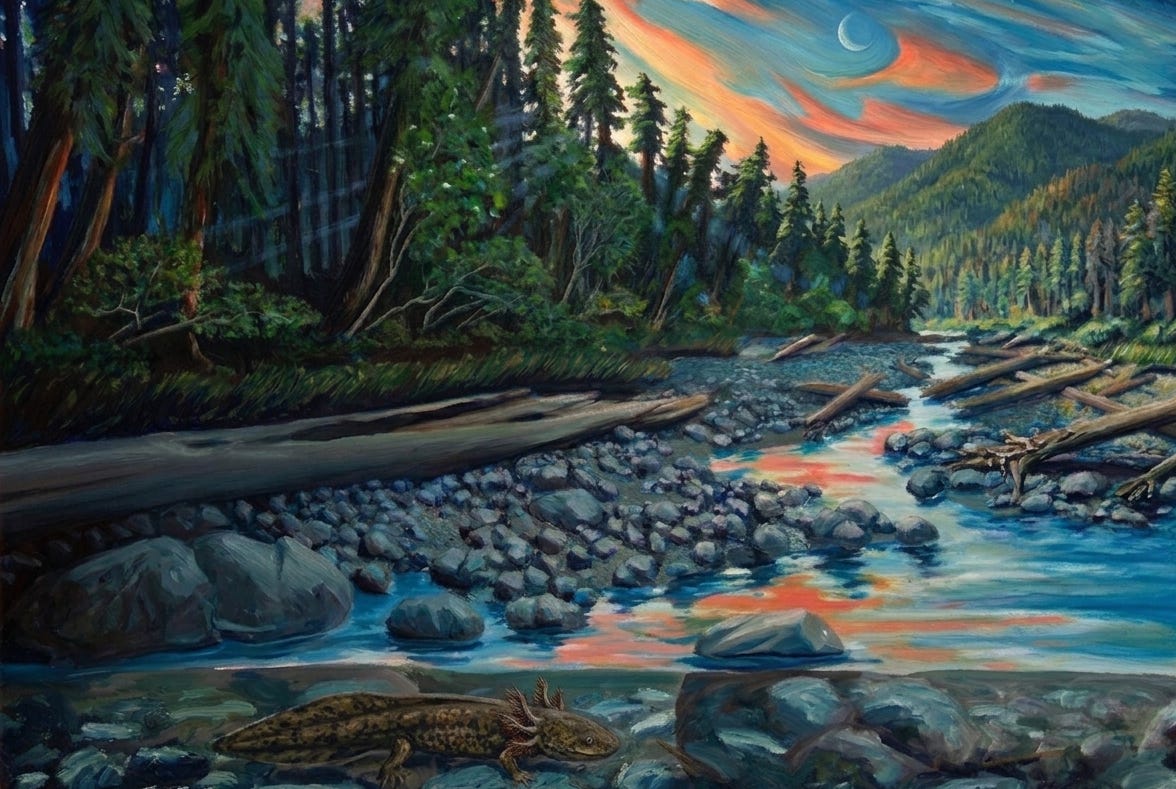
The stream was going wrong. Mid-August on the Bogachiel, deep in the Olympic rainforest, and the water level had collapsed to the lowest I’d seen. Though it was peaceful-quiet the way these woods can be on a morning when the light falls through the big-leaf maples in long columns and the dippers work the riffles. Yet the thin-quiet, tight-quiet, the sound of something stretched past what it was made for, made me take notice.
It’s normal for the mosses to dry out in the summer. But this year, laying in their usual thick pads on enormous big-leaf branches, they had gone the color of old hemp rope. Licorice fern curled tight on those branches, not wanting to spring. I crossed a few cataracts which in other months would’ve run cold but now were rock skeletons, mere shadows of themselves. In the main channel, gravel bars that lay exposed to the dry languid heat were gray and discolored with desiccated, flaky white biofilm. The Douglas-firs overhead didn’t seem bothered, being the kind of creatures that measure time in centuries and consider a dry summer a minor footnote. “Hrum, hoom." I could almost hear. But the Bogi knew. And I felt it. Something was being asked of this place.
It was that summer when heat popped over 100 in Seattle more than once. An outlier, for sure. Outliers happen periodically, though, for a reason. Outliers are not accidents. They can be the ecosystem’s way of remembering what it is. Ecologists have a term for it, disturbance regime, which sounds clinical and detached but describes something almost liturgical: the sacrifice that keeps a place honest.
The great fires, the hundred-year floods, the wind storms, the summers that crack the thermometer, the winters that send forth heavy white weighted blankets: pressing the weak things to their knees. These events look, from the inside, like pure destruction. And they are. But they are selective, and the selection is not random. What the heat hit hardest in the lowland forests were the species that had no business being here in the first place: the ornamental escapees, the Himalayan blackberry with its canes thick and hard like curved, twisted iron cables crowding the roadsides, the reed canary grass that had colonized the wet margins and left no room for anything older. The exotic species, the ones that had arrived with the disruptions of the last century and found the conditions hospitable and spread accordingly, had optimized themselves for the conditions as they were. The heat was nature’s reckoning. The Refiner’s fire.
The conditions as they were is exactly what an outlier dismantles. The natives, meanwhile—the red alder, the vine maple, the sedges, and rushes that have been reading this particular river’s moods for thousands of years, carry in their roots, stems, leaves, and their seed banks a memory of exactly this. Nothing’s new under this sun. The heat is, in a terrible way, a homecoming. A relief from the onslaught.
I was picking my way along the bank through the brambly native blackberry, in no particular hurry, the way you aren’t when you’ve given a weekend to a place that feels like home and have nowhere else to be, when I nearly stepped on it. On the flat of an old gravel bar, motionless in the speckled shade of alder doghair: a salamander, eight inches of it, marbled brown and black and gold, with a muscular rounded tail and—this is the thing—no gills. Just skin, thick and purposeful, the skin of a creature that had crossed over. I crouched down and put my hand out. Would it crawl on me? Of course not: spidey-senses say, reverse course, and away it wobbled.
What I was looking at was, almost certainly, a terrestrial adult Cope’s Giant Salamander, Dicamptodon copei, and if you have never heard of it, good. It’s such a blessing that there are many new things under the sun—for us.
The Cope’s is an astonishing animal. It lives almost entirely outside of human attention: hidden, unassuming, not sexy. It inhabits the cold, high-oxygen streams of Olympic’s rainforest—the Bogachiel, Hoh, Queets, the Quinault—streams so clear and cold and fresh they look like they were made last week, though they have been running since the mountains started rising and will so long after they stop. The salamander spends most of its life in them as a large, gilled, fully aquatic larva, hunting invertebrates and smaller salamanders in the gravel and root tangles of the streambed. It grows to a respectable size. It reaches sexual maturity. Yet, unlike almost every other salamander species on earth, it simply stays. It does not transform and walk onto land. The species is what biologists call obligate neotenic: hardwired, by ancient and elegant genetic arrangement, to remain forever in the larval form. Not because it failed to grow up. Because in the cold, stable, oxygen-rich water of the Olympic Peninsula, being young is enough. It is, in fact, perfect. The stream provides everything. There is no pressure, no necessity, no reason to become anything other than what it already is. Until it must.
The adult form still exists, encoded in the animal’s biology like a word in a language no longer spoken or nostalgia—present, complete, waiting. The tissues carry it. The thyroid hormone axis, the developmental switch that in other salamander species reliably triggers full metamorphosis, is in the Cope’s turned nearly to zero. The door to the adult form is not gone. It is simply, in the language of the genes, locked. What locks it is the stability of the environment. What can unlock it, what occasionally does unlock it, is stress. Specifically: the stress of a stream that is no longer sufficient. Water too warm, too low, too thin, the oxygen dropping. When the environment that justified the larval form begins to fail, something shifts in the animal’s biochemistry. The thyroid axis, pushed past its threshold of resistance, throws a switch that has not been thrown in this individual’s lifetime, perhaps in the lifetimes of many generations before it. And what comes through that open door is the adult form: gills resorbed into the body, lungs awakened, skin rebuilt against desiccation, tail redesigned for walking on earth. A form that was always there, always encoded, always latent—now remembered because the environment finally demanded it.
The salamander on the gravel bar was not sick. It was not a failure. It was more fully itself than it had ever been.
Have you had a disturbance event which cause you to grow up fast?
Life inside the wood between the worlds always feels so remote—so home. No matter the conditions, deep in the wilds, I forget that I live in any known century. And I learn the old stories: the latent ones activated, which are commentary on our world, and are expressions beyond nostalgia.
Let me say this carefully, because I am not interested in the usual arguments, and if you’ve read this far, I suspect you are not either.
We have built, over the past several generations, a remarkably stable stream. I mean this as an indictment. We have engineered a social and economic and technological environment so frictionless, so provisioned, so relentlessly stimulating, that the latent adult form of the human creature—the form that knows how to belong somewhere, how to protect something, how to sit with another person in the evening without needing to be entertained, how to walk and notice things, how to be faithful to a place and to people across decades—has had, increasingly, no occasion to emerge. The juvenile form suffices. The juvenile form has a device in its pocket that will provide any sensation it requests within seconds, a delivery service that will bring any food to its door, a political apparatus that manages its anxieties into the usual talking points and dismissive hand-waving, an economy that has quietly decided that what the larval form consumes is more valuable than what the adult form might build or protect or love. And so we have remained, by and large, neotenic. Comfortable, stimulated, available, and—juvenile.
This is not a conservative argument or a progressive one. The juvenile-keeping has been accomplished with equal enthusiasm by forces from every direction. The technocratic managerial state that believes human problems are administrative problems and human beings are clients to be processed has done its part. The market that discovered it could sell us the simulacrum of belonging—the parasocial relationship, the curated feed, the AI therapy, the like button’s small pulse of dopamine where a community used to be—has done its part. The political entertainment complex that found it could keep us furious and therefore engaged, metabolizing outrage where civic life used to be, has done its part. They are, each of them, simply following the logic of a system that rewards keeping the juvenile form juvenile, because the juvenile form is, in this particular arrangement, far more manageable than the adult.
But the stream is going wrong. And I think we know it.
The dry August on the Bogi is a keen analog to what is actually happening, at the level of human lives. The stream of the old social order—the intergenerational family, the neighborhood with its own coherent life, the church that knew your grandmother, the job that meant something beyond a number in an account, the porch where the evening was spent in actual conversation with actual people—that stream has gone low and thin and thick with drapes of algae. And the evidence of the stress is not subtle. It is in the encampments and the drugs and the too-soon obituaries and the family courts and the therapists’ waiting rooms and the faces of the people who have not slept well in years but cannot tell you why, the people who have everything the juvenile form requires and feel, persistently, like something is missing that they cannot name.
What is missing is the adult form. And stress is key to unlock it. Maybe not quickly nor cleanly, not on any schedule that would satisfy the people who manage such things, but in the way that water finds its level, in the way that a seed bank waiting fifty or more years finally meets the right season and simply, without announcement, begins.
I am not speaking of a political movement or a cultural program or anything administered from outside. I am speaking of something I have watched happen in particular people, quietly, usually after some threshold has been crossed that made the old arrangements impossible to maintain. A marriage that finally tells the truth. A man who loses everything and finds, in the losing, that what he lost was not the thing he thought it was. A woman who walks away from the device and into the yard and stands there in the summer evening air and notices, for the first time ever, that nighthawks are in flight with their peculiar buzz, and thinks why didn’t I ever notice. The moment when someone who has been metabolizing the world through a screen, puts the screen down and sits with another person and says something true and is received. The family that, stripped of its illusions about what it was supposed to look like, discovers what it actually is and decides to be that instead.
These are epigenetic events. They are raids in the thyroid axis of the human soul pushed past its threshold of resistance. The door flies opens onto the adult form.
And the adult form, when it comes, does not look like the advertisements. It does not look like productivity or optimization or self-actualization or any of the preferred juvenile ambitions. It looks like people learning, slowly and with difficulty, to be in the same room with each other without an agenda. It looks like someone who had forgotten how to take a walk remembering, and finding, somewhat to their surprise, that the world is still there and still beautiful and does not require any improvement. It looks like the recovery of the simple, difficult, unglamorous competencies of human adulthood: showing up, keeping your word, making food for people, staying when you’d rather leave, loving someone other than yourself across the long middle of a life that doesn’t resolve into any clean narrative.
"He has shown you, O mortal, what is good. And what does the Lord require of you? To act justly and to love mercy and to walk humbly with your God" (Micah 6:8).
This adulthood, looks like coming home to a form that was always there, waiting in the tissues of the creature, needing only the right—or the wrong—conditions to finally emerge.
I keep thinking about what the biologists note about the Cope’s: that the terrestrial adult form carries no advantages it did not already have, encoded and latent, in the larval phase. The lungs were always a possibility. The thickened skin was always a possibility. The capacity to walk on the forest floor, to navigate a different world, to survive in the open air—all of it was always present, waiting in the developmental memory of the animal. The stress did not create anything new. It unlocked what was already there.¹
This is what I believe about the people I know who have found their way back to something real, which I am careful not to call a better life because that phrase has too much upward mobility in it and what I mean is something more lateral, more rooted, more a matter of depth than height. They have not become new creatures. They have remembered the old form. They have stopped performing the juvenile adequacies—the scrolling, the managing of impressions, the consumption of experience as though experience were a product—and have discovered that underneath those performances there was always something else: a person capable of faithfulness, of presence, of the slow and unspectacular work of actually living with other people in an actual place.
The rains will come back to the Bogachiel. They always do. The stream will rise again, cold and blue-green and deep, and the ferns will unfurl, and the oxygen will return to what the cold-blooded creatures of this forest have relied on for millions of years.
The switch was thrown. And the form that came through the open door was not a diminishment of what the creature was. It was the completion of it.
I think we are being asked, by the stress of this particular dry season in the life of our civilization, to do the same. Not to progress to something we have never been. To remember what we always were. To discover, in the difficulty of the moment, that the adult form was encoded in us all along—waiting with no shame.
To take the walk. To sit at the table. To look at the person across from you and actually see them. To protect something. To belong somewhere. To be, against all the pressure of the age, genuinely, quietly, stubbornly human.
¹ Zelenka, D. D. (2025). *Recrystallization of Memory: A Theoretical Framework for Evolutionary Dynamics Across Scales.* Zenodo. https://doi.org/10.6084/m9.figshare.30437897
All of your writings are so very thoughtful David. This one is particularly a good read that resonates with me and will stay with me.
Thank you