
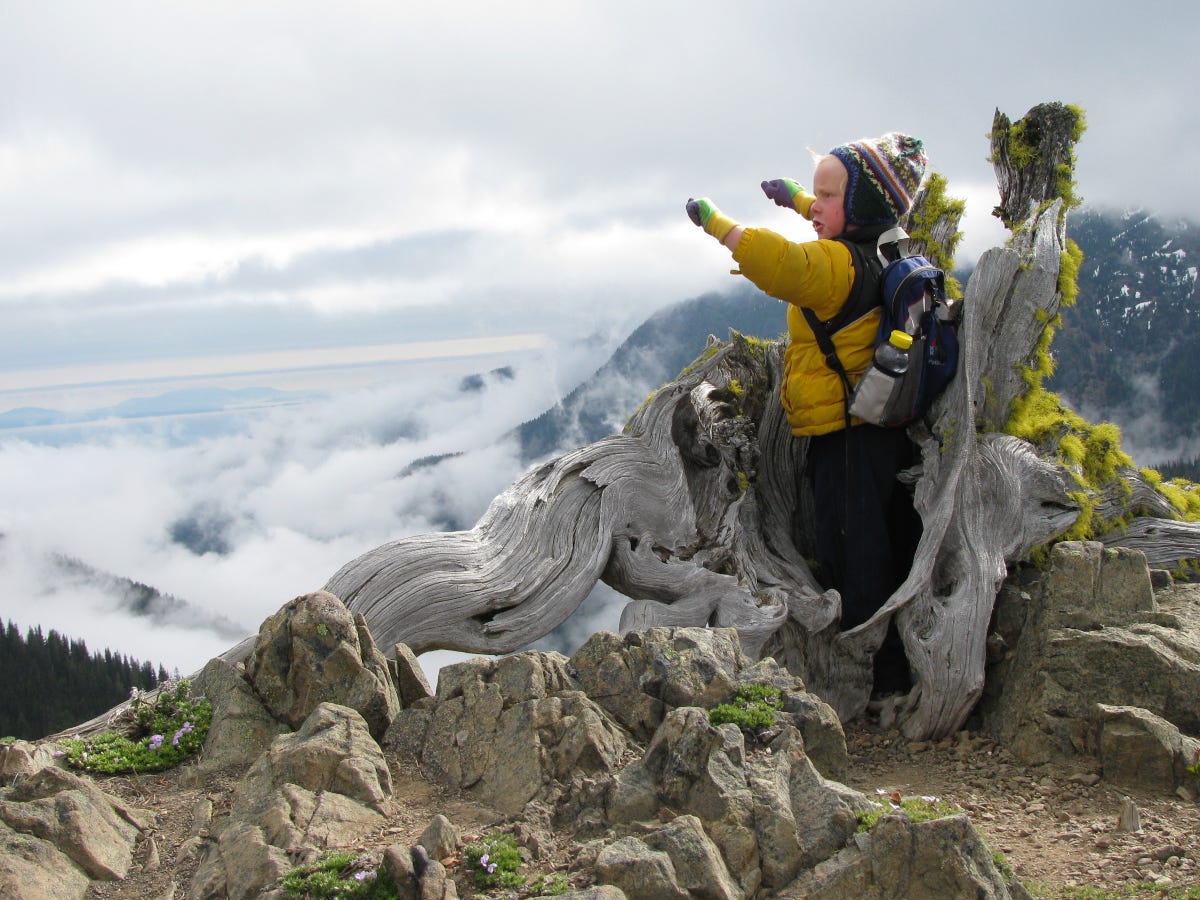
This photographic keepsake from our son’s childhood is what we’ve affectionally titled, “Master of the Universe.” You may know that exact tree and those vibrant lichens if you’ve hiked a special way trail near Hurricane Hill. Reminds me a modern baby Gandalf about to give a baby Balrog a what-for.
I hinted in my previous article that wilderness really isn’t a thing. And why should it be? Our modern perception of wilderness is a place where—we ain’t. Political wilderness boundaries in the modern sense are places where human interaction is limited to hiking, some camping, no fire zones. Chainsaws are not allowed in some jurisdictions even to clear trails. Don’t get me wrong, I love natural places and don’t want them commoditized or even mechanized. They are where I meet God most easily. Second only to—did you guess it?—people.
(I do not intend to discount the beauty of scripture and sacraments. My emphasis is that creation and his people are living, breathing examples of his love and providence.)
The kingdom of heaven is nigh, not where people are excluded, but where man is merged with his Creator. This is what the incarnation is—Jesus. Wilderness too.
I’ve long thought that wilderness boundaries are backwards facing. My place is in God’s creation and the true boundary is that of human civilization. I’ve long sought the merger of the two. Though the sharp contrast exists, even aerially, one way to understand the difference is analyze the difference between violence and the destructive forces found in nature. Man exhibits violence. Nature generates cycles.
In wilderness: storms snap trees in half, animals succumb to the blaze of fire, currents rip kelp from their holdfasts, waves thrash as seastars and limpets cling.
But are these acts of violence?
Not even to mention my now-twenty baby-Gandalf, who engages every free day he has off from work hunting, fishing, and generally pursuing any and every activity he can in these wilds. These pursuits are only violent when cruelty is involved. I taught him early on, if you kill it, you eat it, in an attempt to prevent cruelty toward God’s creatures.
In the not too distant past and even today on certain lands and seas, wilderness, has had a different meaning than our modern bureaucratic definition. Yes, it was the wilds, but it was also the place where you’d find cruel men. When you left the gates of your walled city or journeyed from your locked and barred home, you entered the wilderness distant from civilized protection. There, lurked, not only men who would steal and destroy, but also evil faeries and demons which haunted each step.
Through this picture—the wild west, the Arabian desert, the ancient forests of Northern Europe—we can begin focusing our lens so we may understand violence and prevent our participation in what is cruel. This is where it should get unsettling to each of us, because violent action is not only physical, it is psychological, and worse—spiritual. This is the main source of violence in most of our world, and which we participate. Any and all narratives which push dystopia are forms of psychological and spiritual violence:
Hope is just wishful thinking.
Bad guys rule the world. Deal with it, Honey.
The future is bleak.
Come on, give up trying. Second or third best, is the only outcome you can ever expect from this cruel world.
These are mind viruses that are antagonist to kingdom-thinking. Although no physical damage is done, this is pure violence of the soul. Manipulating actors use these memes (in the mimesis sense) to get inside your mind and heart to control your behavior, reduce your agency, and destroy your God-given liberty and joy.
This is why Peter presses his listeners to “be born again to a living hope through the resurrection of Jesus Christ from the dead.” And why the primary theme of Tolkien’s Lord of the Rings is to keep going in love and fellowship, while trusting in goodness, even as hope diminishes beyond all recognition.
We are promised that the violent and cruel will eventually run out of fuel and when it does, it will self-consume to oblivion.
Don’t let yourself be drawn into that vortex. Read the beatitudes to find out how. From Eugene Peterson’s The Message:
You’re blessed when you’re at the end of your rope. With less of you there is more of God and his rule.
You’re blessed when you feel you’ve lost what is most dear to you. Only then can you be embraced by the One most dear to you.
You’re blessed when you’re content with just who you are—no more, no less. That’s the moment you find yourselves proud owners of everything that can’t be bought.
You’re blessed when you’ve worked up a good appetite for God. He’s food and drink in the best meal you’ll ever eat.
You’re blessed when you care. At the moment of being ‘carefull,’ you find yourselves cared for.
You’re blessed when you get your inside world—your mind and heart—put right. Then you can see God in the outside world.
You’re blessed when you can show people how to cooperate instead of compete or fight. That’s when you discover who you really are, and your place in God’s family.
You’re blessed when your commitment to God provokes persecution. The persecution drives you even deeper into God’s kingdom.
Not only that—count yourselves blessed every time people put you down or throw you out or speak lies about you to discredit me. What it means is that the truth is too close for comfort and they are uncomfortable.
Walking barefoot in the sand along our wilderness coast, my toes redden in the cold water, my eyes smart and seep from the impact of salty, misty winds. Eons of crashing waves have ground-down rock and thrashed countless trees till they appear as coastal krummholz, diminished to their proper accounting in this treacherous landscape. Gulls feed in mass on herring schools. Sealions shred salmon. Waves upend trees, piling them like bone gardens at river mouths. Yet none of this is violence.
Violence is cruelty intended on enslaving the will of another through destructive force or coercion. The intended outcome of violence is to subjugate the other into the same pathetic state of the abuser: death of spirit but not of body.
What is the difference between violence and a lightning strike which sends a redcedar splintering in a 200-foot radius, flaring up beyond full height in minutes?
A redcedar burns out and becomes a home for countless different species: bats, bears, swifts.
Dare I add, what is the difference between the wrath of God and a violent man?
God’s wrath is the only action which can forever terminate the continuation of the violent and cruel. And this is why Christians place emphasis on the cross. It is the only gate to the endless cycle of violence and retribution.
Yet we cannot ignore the questions which lay bare before us: What is war? When, if ever, is it not simply perpetuation of violence? Is it possible to battle without cruelty? Can man participate in administering the wrath of God?
Sorry, my paygrade is too low to answer these. But generally, my sniff test is simple: be very wary of anyone using just war doctrine to justify war.
This is why I return to the wilderness. There, I see life in all its stages, unmolested by the violence of men. It’s more than a study. It’s an incarnation. The Creator enters into us: His beauty, His turnings, His starkness, His stories.
And when and if a time for war comes to my home, I will be better prepared to recognize him and his answer to my cry: Where God are you in it all?
But he himself went a day’s journey into the wilderness (1 Kings 19:4).