The Flower That Doesn’t Know About Politics
A Conversation on Mount Angeles

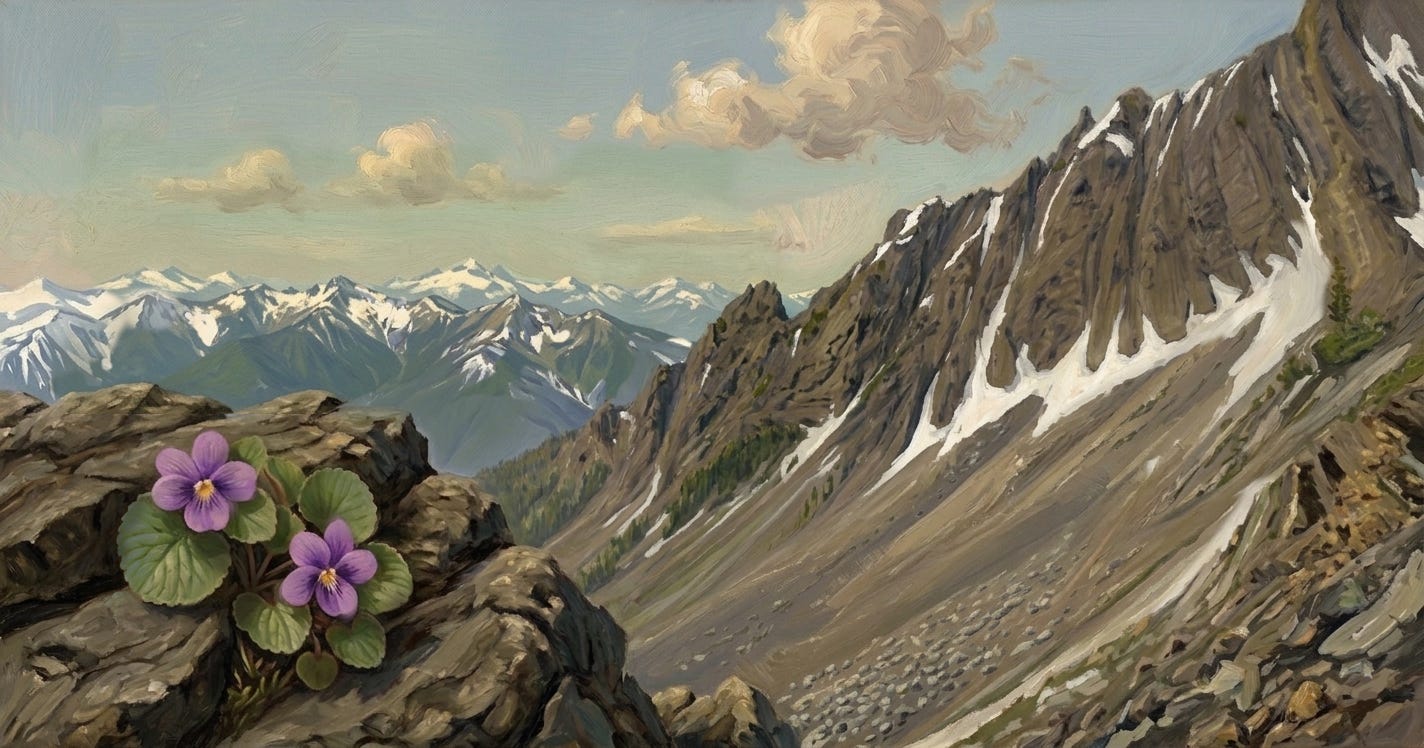
He was stopped in the middle of the scree field, about two hundred feet below Mount Angeles, breathing hard. Trekking poles, gaiters, a hydration pack with a hose clipped to his sternum strap, a hat with a sun flap, sunglasses that probably cost more than my pickup. He looked like REI had sponsored him. I came up the slope in running shoes and a t-shirt with flannel, water bottle shoved in my pocket.
He was exactly where you don’t want to be on scree: dead center, where the rocks have no purchase on each other, where each step sinks and slides and costs twice what it gives. I angled past him on the edge of the field where the slope meets the solid rock wall, where the footing is locked in and you just walk the rock stairs.
“How are you doing that?” he called.
“Walk the edge,” I said. “The middle is the hard way.”
He looked at me like I’d said something either obvious or profound. Maybe both.
He caught up to me at the top. The day was one of those May gifts this peninsula hands you sometimes; clear all the way to Victoria across the Strait, the whole white line of Olympic peaks stacked south like frozen waves to the south, a breeze just strong enough to keep the air alive. Oh, and the lovely Little River with her silent hum hidden below. We sat on separate rocks and didn’t say anything for a while.
Then he gestured at the panorama and said something about how it must be nice to live here, being surrounded by all this, and how the world was going to hell, and wasn’t it hard to stay sane.
I knew what he meant. You can feel it even up here, the grinding hum of something in the background of everything. Algorithms and outrage and the sense that someone far away is trying to manage your mind.
I pointed at a cavity in the rock near his boot.
“See that.”
Tucked into a crack in the sandstone, not six inches from the rubber sole of his boot, was a Flett’s Violet. Viola flettii. Five petals, purple-veined, maybe as big as your thumb. It grows in nowhere else on earth. Just here: the rock faces and ridges of the Olympic Mountains. It blooms for a few weeks in May or June and then it’s done. This particular plant may have been growing in this particular crack for decades.
He stared at it for a long moment.
“What is it?”
I told him it was endemic: a thing that belongs completely and exclusively to one place, that it evolved in these rocks, with the right amount of yearly fog and snowpack and summer light, over thousands of years. That it is not found anywhere else because it did not become anywhere else. It became here.
He was quiet.
“That’s comforting,” he finally said.
“Isn’t it,” I agreed.
There’s a mathematical principle—stay with me, this matters—about the difference between problems that are easy to generate and problems that are hard to reconstruct. A maple tree produces ten thousand seeds at almost no cost. Each seed is a compressed packet of information, a tiny blueprint. But if you tried to work backward from a seed to reconstruct the exact history of the specific tree that made it—the particular growing season, the drought in 2009, the branch that broke, the soil chemistry—you’d find it was effectively impossible. The forward direction is cheap. The reverse search direction is astronomically expensive.
I call this the Maple Tree Problem. And it turns out it describes most of what’s actually hard in this world.
The progressive technocracy—and here I mean not any particular political party but the whole machinery of algorithmic management, administrative standardization, metric-driven everything—operates like this, yet with one critical distinction. It is very good at a specific forward direction: flattening, standardizing, collapsing a thousand distinct human communities into one managed output. Each regulation, each platform, each system is a small cheap step in that direction. But going the other way? Reconstructing a genuine community with memory and rootedness and a shared way of life from within the managed output? That’s the hard problem. That costs Ω(n log k), which is mathematician’s shorthand for: it gets more expensive the longer it runs, not less: if and only if, you’re working within that system. The way out: limit the time your mind spends in that prison, I mean system.
Rod Dreher has been writing about this for years in is trilogy The Benedict Option, Live Not By Lies, and most recently Living in Wonder. What he keeps arriving at is that you cannot win by fighting the machine on its own terrain. You cannot out-argue, out-organize, or out-resource a system that is doing the easy work while you do the hard work. The math is rigged. Every move you make in their search space costs you more than it costs them.
But there is another mathematical regime. Entirely different search space: from where you became. When you’re not reconstructing from inside a collapsed space but generating forward from a living one, when the solution is physically instantiated in your actual life rather than being computed from scratch, the costs invert. Raising children in a tradition is O(n): you do the next thing, you show up, you hand down what was handed to you. The costs are real but they scale normally. Living in a place long enough to know it, long enough to know where scree field holds, is the same. You just walk. The knowing is already in your feet.
This I’ve labeled this the trivial boundary: the regime where the problem is already solved because the solution exists in physical form, tested across time, paid for by the people who came before you. You don’t compute the answer. You inhabit it.
The critical distinction I hinted at earlier regarding progressive technocracies is enormous piles of waste products.
Look around up here on the mountain and notice the difference. There is no trash dump on Mount Angeles. The bleached branch that fell off that subalpine fir thirty winters ago is still lying slightly lower than where it landed, slowly losing mass, working its way downslope into something the next generation of roots can use. Nothing is wasted because nothing is discarded; it’s all still in the conversation, moving at a different speed. The mountain is doing what healthy systems do: cycling everything back through. Death is just a slower kind of growing.
But with us humans, you’ll find real trash, the appliances in the blackberries, the trailer with the caved roof, vast quantities of grime packaged up and sent from our Regional Transfer Station hundreds of miles to Klickitat County. Have I mentioned the heart waste: broken people and broken families?
These are not signs of pure laziness. They are signs of a system working very hard in the wrong direction: producing outputs that have nowhere to go, that don’t feed anything forward, that simply accumulate. Waste is the exhaust of a machine running against the grain of how living things actually work. The mountain has been here longer and it has no exhaust.
Flett’s Violet doesn’t fight the elevation or snow or wind. Just comfy. It doesn’t argue with the rock about conditions. It doesn’t try to grow somewhere more reasonable. It goes deep into exactly where it is, and it flowers, briefly and completely, and it has done this longer than the ideas currently tearing at us have existed. It will be doing so long after those ideas are gone.
People wonder why I’m optimistic. Living in faith is the trivial boundary for humans, what’s been called “the narrow path.” Do I, living in the world, get stressed in the machine’s regime? Sure enough. But then I look to the mountains and rest in the Rock of Ages.
The endemic mind is the one that has gone deep enough into something real—a place, a practice, a faith, a family, a craft—that it is no longer primarily defined by what it is resisting. It is defined by what it is. The political climate is loud and it is genuinely threatening, but it is not the only climate. There is another one, quieter and older, and it runs all the way down. Deep.
Go find work that will outlast you. As the wise have often said: plant things you will not harvest. Learn the names of what (and who) grows at your elevation. Walk the edge of the scree field, where the rock is locked in and the footing is sure. Love the people who are geographically close to you, which is to say love the people God actually gave you. Learn how to bake sourdough bread that has nothing to do with the news cycle. Say the old words, “I love you,” even when they feel strange in your mouth, because they were shaped by people who survived worse and knew things you do not yet know. Let the children get bored. Sit on a rock above the Strait until your ambitions look appropriately small. Find the flower in the crack and do not step on it. Tend the memory that belongs to where you are, because memory is the only thing the machine cannot print and the only thing that makes a place more than a location.
Faith is the original version of this. Not belief in the skeleton of evidence, but the settled posture of someone who knows which way the river really runs, who is not computing their way toward flourishing but receiving what has already been prepared. My yoke is easy, my burden is light, He breathed. This is not a therapeutic affirmation. It is a computational claim. It means: you are not doing this alone, you are not doing this from scratch, and the most important things are not the hardest things, they are actually the most easy, once you are in the right regime.
The man in the right gear came down the mountain behind me. He walked the edge of the scree field. He moved faster than on the way up, more easily, almost without thinking about it. Funny thing is I went down the middle. It’s much faster going with gravity. Rock skiing I call it.
That’s all it takes, usually. Just the right place to put your feet.
Technical papers:
Zelenka, D. D. (2026). When P = NP: Natural Systems and the Trivial Boundary. Zenodo. https://doi.org/10.5281/zenodo.18566802
Zelenka, D. D. (2026). Computational Irreducibility and the Maple Tree Problem: A Structural Resolution via Operational Gradients. Zenodo. https://doi.org/10.5281/zenodo.18210078