On Time Every Time
On aging gracefully, gravity wells, and what hummingbirds and elephants might think

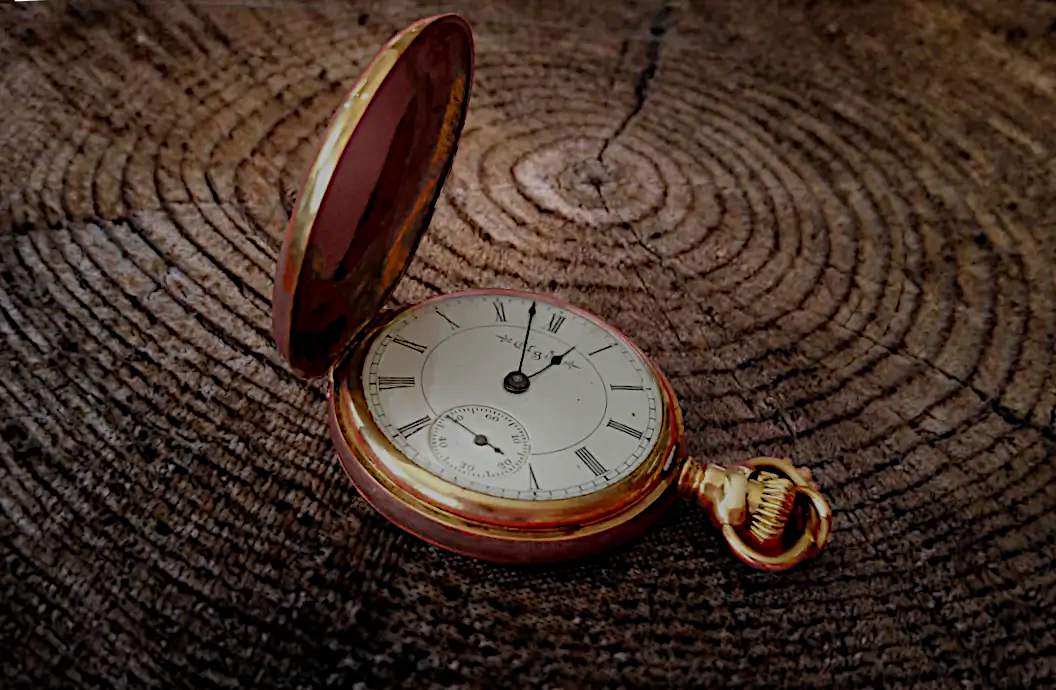
My dad asked me the other day, “What is time?” He wanted more than the pat response I usually give: time is a construct, time is change, now is all we got, and so on. He’s a big fan of Eckhart Tolle, author of The Power of Now. So I’ll take up his challenge.
Dad turns 90 this year. That’s a lot of trips around the sun. Uranus, by comparison, only made it back to where it was in 1936 four years ago. That’s a long way around. Here’s a fact I like: one minute of one degree of latitude is exactly one nautical mile, by definition. The Earth turns through that same minute of arc in almost exactly four seconds. These days, one mile is a good distance for my dad to walk. My father’s mile and the planet’s four seconds are both time, and neither one explains the other.
There is a time for everything, and a season for every activity under the heavens.(Ecclesiastes 3:1)
Have you watched Interstellar? I had a visceral response to that movie, which may mean it’s excellent. But it hurt to watch—terribly. A father abandons his daughter to save humanity from a dying Earth. As a parent, the nostalgia of a man missing her growing up years, watching her age through video transmissions, living a whole life without him, sits under the whole film like a lifetime of heartbreak.
But there’s a scene that gets at something. On a planet deep in the gravity well of a black hole called Gargantua, an hour passes for the crew on its surface. Back on the ship, orbiting farther out where gravity’s grip is looser, twenty-three years pass for the man they left behind. Nobody’s clock feels slow to the people living it. An hour is an hour, wherever you are. It’s only when the two crews compare notes afterward that the gap is revealed between them. Interstellar gives us a deeply compelling story-model of time. Even still, the why and the what remains elusive. Just what is yesterday, today, and tomorrow?
All physics models reality using some picture that tries to capture its nature, and none of the pictures—not even pure math—do it justice.
The carbon cycle model helps us understand that there’s a flow, a going-out and coming-back, but nobody has ever pictured a molecule of carbon dioxide, or watched it dance with its oxygen neighbors. We build models because we must see something, even knowing the something isn’t quite the thing itself.
I’ve built one of these pictures myself. I call it Fabric1, and it treats reality less like a clockwork machine and more like an ecosystem. In this view, light comes first (John 1:1-3), weaving itself out of a formless, timeless substrate into the particles and atoms that become everything else. The weaving comes before the woven. Verb before noun. Which is, I’d point out, the same order Genesis gives us: God spoke, and then things were. He is Creator first. His creations come second.
Here’s the core of it, as best as I can put it. Time isn’t a track you ride along. It’s more like depth, the way a tree has depth in its rings—and trunks, branches, and leaves. Every place accumulates its own depth at its own rate, depending on how much is going on there, how crowded and busy the weaving is. Your body, your biological clock, your heartbeat, they don’t measure time passing through you. They measure how much depth has built up in you.
And this is why mass slows things down. Near a planet, near a black hole—say Gargantua, the black hole in Interstellar, and Miller’s planet, the ocean world sitting deep in its gravity well—the weaving is thick like molasses and busy, crowded with the business of holding all that matter together. Each moment away from that crowded mass, light can weave faster. Out in the open sky, light is free to do its work, unlike when it pushes through the crowd. So for Cooper and Brand, standing ankle-deep on Miller’s planet, their hearts beat slower and their thoughts stretch longer, though it feels perfectly normal to them the whole time, an hour like any other hour. Farther out, on the ship where Romilly waits, the weaving runs thin and unhindered, and depth piles up faster. More living gets done per moment shared. Twenty-three years of it, while an hour passes below.
Mass doesn’t slow time down like a hand on a clock. It thickens the room the light has to weave through. And what you call time is just how deep that threading has become where you happen to be standing in it.
In the forests and fields we see the same pattern, and it isn’t hard to find.
Walk into a dense stand of Doug-fir doghair that grew in too thick, and you’ll see it in the trunks themselves: skinny, thin-ringed, straining upward for its sliver of light, each tree’s growth throttled by how many neighbors are drinking from the same soil and sky patch. Thin the stand, so trees are less dense, and the survivors put on inches a year they never could have managed crowded. The same rain falls on both stands. The forests tell different stories depending on how many are competing.
You see it in a herd, too. Overstock a pasture and every animal on it puts on weight slower, matures later, than the same animal would on open range. The land doesn’t change. The crowding changes what the land can give each one of them.
What these share is this: the more crowded a thing gets with more of itself, the slower each part of it moves through its own life. That’s the forest and the feedlot confirming, each in its own key, what Gargantua tells the astronauts: living close to the weight of things slows the living down.
If crowding throttles the rate of things, then what is this thing we call gravity that slows the weaving down? Why does a stone attach to a mountain, or rain gather itself into a river?
Start with what a stone actually is, in this fabric picture. It isn’t a separate thing dropped into the weave from outside, the way a pebble drops into a stream. It’s a knot twisted into the weave of fabric itself, made of the very thread that surrounds it. And a knot doesn’t get pulled by the threads it’s tied with. It settles. It holds whatever shape costs it the least strain, given how the weave lies around it. Tie the same knot in slack weave and in taut weave and it won’t rest the same way in both.
Now thicken the weave on one side, the way mass thickens it near a mountain or a sun. The knot’s easiest, least-strained shape is no longer centered where it happens to be sitting. It’s a hair’s width closer to the thick side. So the knot re-orients, moment to moment, toward that easier shape, and the easier shape keeps being a hair closer still. Nothing reaches in and drags it. It just keeps finding, over and over, that resting comes easier a little further toward the crowd. Do that enough times and what you’re watching, from outside, is a stone falling.
That’s why the river runs downhill without anyone yanking it, too, though the river’s case is easier to see with your own eyes. It runs downhill because the ground tilts that way, and because everywhere along its banks, the water finds it easier to keep moving toward less resistance than to fight back up the slope it came from. No pulling. Just a landscape that isn’t flat, and water doing what water does on a landscape that isn’t flat, the same as the stone doing what a knot does in a fabric that isn’t evenly thick.
I think the Earth circling the sun works the same way, just harder to picture at that size. And I suspect this is why things spin at every scale, from planets to storms to the shells of snails: the most fundamental knots in the weave carry a handedness, a chirality, and a knot with a handedness doesn’t just slide toward a gradient, it spirals into it, the way water doesn’t just flow toward a drain but curls as it goes.
Nothing reaches out from the sun and grabs the Earth. Nor the Earth towards the sun. The Earth simply keeps finding that its most comfortable, least-strained shape lies a little further in the sun’s direction than where it was a moment before, but because it has a forward velocity, the distance breaks even into an orbit. It’s settling, the way water settles downhill, the way a root finds the damp soil without anyone telling it where the water is.
But do not overlook this one fact, beloved, that with the Lord one day is as a thousand years, and a thousand years as one day. (2 Peter 3:8)
I like how the English Standard Version translates τοῦτο as “fact.” Let’s run a thought experiment on that fact. Suppose we could zoom far enough out to watch both crews on the screen at once: the astronauts down on Miller’s planet, and lone Romilly on the ship above them. The ones near the deeply threaded mass would seem to move in slow motion, unfolding like a nature film on the tenth of its speed. Romilly, out where the weaving runs freer, would flicker across the deck like something sped up, a man living a whole watch of years in the time it takes his crewmates to blink.
We don’t need a telescope trained on a black hole to see this. A hummingbird’s heart can beat a thousand times in a minute, and its whole life passes in a few busy years. An elephant’s heart beats slow and heavy, and it carries that same slow heaviness through six or seven decades of protracted, unhurried motion. Different weights of living, threading at different depths, right here on the same Earth.
To me, time travel is wonderful for books and fantasy, but the only time travel I ever experience is a good night sleep. Eight hours in a blink of an eye. Boy, isn’t that nice—when that happens.
That, at least, is as far as I can go without equations, and equations were never going to explain it properly anyway. If something’s true, it should show up in living, moving things, not just in the math. What explains it to my dad is a mile of gravel road, walked slower, full of ruts and rocks and the give of loose stone underfoot, than the same mile would go on a stretch of fresh, smooth asphalt.
I walked out to the mouth of the Elwha the other day with him, my sister, and my wife to where the river gives up the business of being a river and becomes the strait. The current has slowed there. Saw a salmon testing the waters. The waves were coming the other way, salt water folding back over fresh, both of them doing this same trade every day since before there were people to count the days. Somewhere upstream, the river is young and steep and impatient. Down here, it’s slow and done arguing. Same river. Different depth of the same water, further along in what it’s always been becoming.
The Preacher had it right before anyone had a name for gravity or a black hole to point a telescope at: “A time to be born, a time to die. A time to plant, a time to pluck up what’s planted.” The generations go, and the generations come, and the river runs into the sea, and the sea is never full, because the water goes back to the place where the river flows. My father’s mile, the tree rings in a thinned stand, the twenty-three years and the one hour, the Elwha meeting the strait: it’s all one weaving, running at whatever depth the crowd of things around it will allow, and none of it stops for us to catch our breath and figure out what exactly to call it. So I call it beautiful.
The Threading Dynamics repository contains research, analyses, and datasets relating to the Fabric model, a conceptual framework that interprets reality as a living fabric of light, memory, and agency. https://github.com/davezelenka/threading-dynamics