Miracles - Living the Scriptures (Part 4 of 4)
On pulling out the dusty training manual

I want to start this last one somewhere I haven’t taken yet in these four parts, and that’s back before the garden, before the tomb, before any of it. Before Genesis even, if you can picture such a place.
In the beginning was the Word, and the Word was with God, and the Word was God. He was in the beginning with God. All things were made through him, and without him was not any thing made that was made (John 1:1-3).
Word, in the Greek there, is Logos. And I have come, over these essays on miracles and the years of studying that fed into them, to believe that Logos is not just a fancy synonym for speech or reason. Like many men and women of faith before us, I believe Logos names the actual living and breathing of the universe. Not a description of how creation works from the outside, like the way a man might write up a manual for a machine he didn’t build. The operation itself, walking around in a body, eating fish on a beach with his friends after rising from the dead. Yes, the person, Jesus.
Here's what I've laid out across these parts. First, the idea that within the unseen substrate of nature, God's creation is poised to emerge, like seed corn in the ground. Second, the reaching that costs something, like a woman pushing through a crowd just to touch the hem of a coat, and paying for it in exhaustion, hers and his both. Third, that it is somehow also a light burden, with abundant leftovers in the baskets, because nothing gets wasted in God’s rightly-threaded universe.
All of that, I pray, is a description, clumsy and partial as any human description has to be, of what he already is. He isn’t a man who learned to operate the threading loom well. It’s what he does, what he is: wearing skin, walking dusty roads, healing a blind man in two stages because apparently even the Logos himself sometimes works a thing one layer at a time, same as the rest of us have to.
Which brings me to the question I’ve been circling now without quite landing on. If he is the operation itself, and we are told plainly that we will do greater works than these, what exactly are the Gospels for.
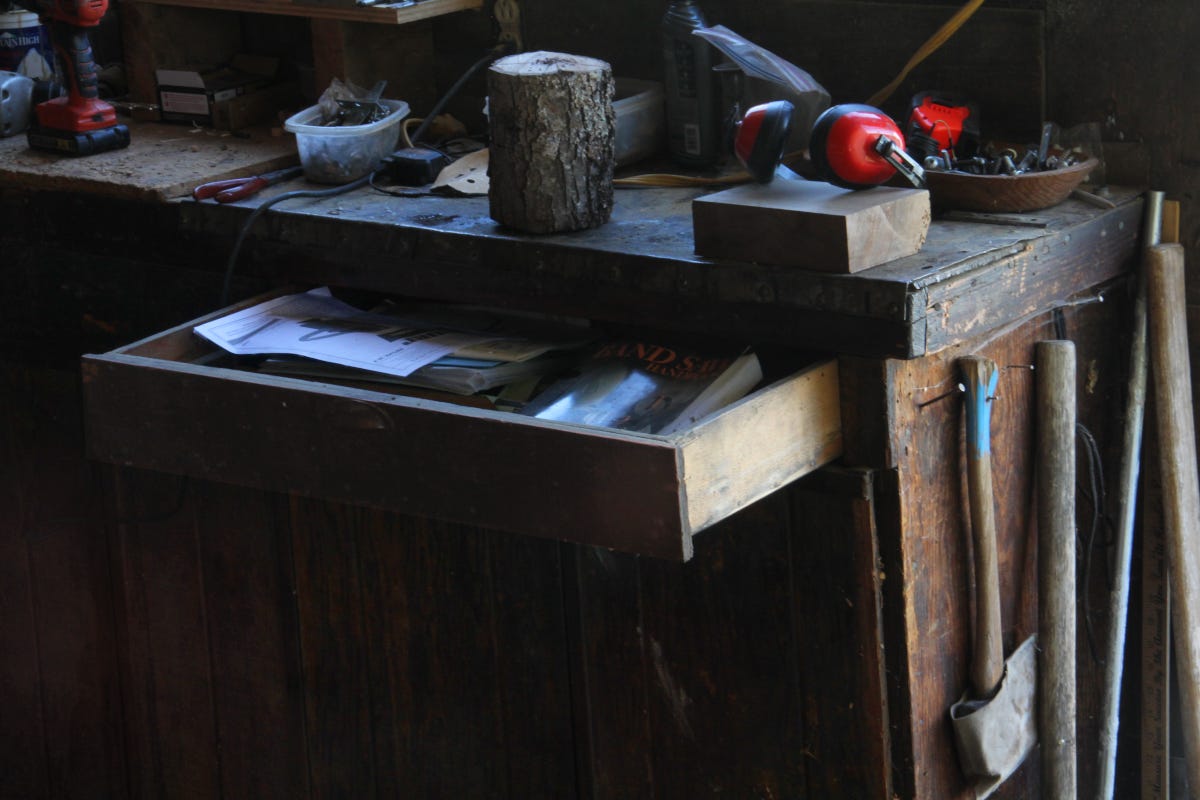
While, it does seem that the Gospels are an ancient proof-text, making clear the I AM became flesh. I don’t think they’re simply a record. A record is something you keep so you don’t forget what happened, a remembrance, the way one might keep a log on sheep in the field. Useful for clarity. I’ve come around to thinking the Gospels function also like something out of my shop bench’s top drawer. A training manual, to be exact. Not four books telling you what once occurred through and to a man in Judea two thousand years back. Four books built to change the reader who is actually reading them or snippets, right now, on this morning with coffee going cold. They called him, “Teacher,” after all.
Watch how it’s actually taught. If you look closely, Jesus doesn’t just sit the twelve down and lecture them on the theory, the way I might sit down and try to explain algebra to my students. While he does tell parables and stories, he also lives it directly in front of them—with them. Loaves multiplying while they’re passing the baskets. Then, not much later, he sends them out to do the same, and Luke tells us plainly they went out and did it, healing and driving out sickness village to village, not because they’d mastered some deep theory, but because they’d watched it enough times, close enough, following behind him long enough, that the pattern had gotten down into them.
A disciple is not above his teacher, but everyone when he is fully taught will be like his teacher (Luke 6:40). Fully taught. Not fully informed. There’s a difference between a boy who’s read every page in a woodworking manual and a boy who’s stood at the bench beside a teacher watching where the grain wants to go. One of them knows about the chisel. The other one what the chisel actually does.
So the Gospels train. But train toward what? That’s the question I think this whole series has really been circling, and I want to say it straight now at the end.
Not toward power. A training manual aimed at producing men and women who can do impressive things is a dangerous document to hand out, so that couldn’t be the document we’ve been given. Every real working in these books bends away from the announcer’s chair, same as I said before, and bends instead toward something else entirely.
A new commandment I give to you, that you love one another: just as I have loved you, you also are to love one another. By this all people will know that you are my disciples, if you have love for one another (John 13:34-35).
Not, by this all people will know you have power. By this they will know love. That’s the tell. That’s the operation everything is bent toward, and it was the attractor from the very start, back before the first miracle, back before the garden of Eden even had a garden in it.
Love, in this frame, is the operation where your own reaching, your own agency, your own cost paid, gets spent maximizing somebody else’s story rather than your own. Not your own healing. Not your own reputation for faith. Somebody else’s wound closing up. Somebody else’s four days in the dark ending. The whole direction of the arrow points outward, away from the self doing the reaching.
That’s why the wrong-aimed miracle fails even when the power in it is real, which we talked about back in Part 2. It isn’t fake power under those hot lights, necessarily. It’s power aimed at the self instead of the other, the announcer’s glory rising instead of the sick man’s wholeness, and a working aimed that way, even a real one, has already collected its wage in full the moment the crowd applauds. Jesus told us that in Matthew’s version straight up: they have received their reward.
And that’s why the easy yoke from Part 3 isn’t a contradiction of the cost from Part 2. The yoke is easy because love, rightly threaded, was never meant to be carried alone. Bear one another’s burdens, and so fulfill the law of Christ (Galatians 6:2). A burden shared threads lighter than a burden hoarded, same as two men carrying a fir log split the weight the log never asked either one of them to carry by himself. The tree’s whole root system, all those decades of hidden growing (and the seeds before it) I told you about, wasn’t grown by one root working solo. It was grown, root to root, tree to tree, the whole hillside holding itself up together. Ecology before it was theology, or maybe theology all along and we just hadn’t the eyes yet to call it what it was.
I fall prey to wanting things to change before I change. And although it is said that timing is everything, we can prep the garden for spring—enhance the soil, sharpen the hoe, clear the paths, and prune the grapes, apples and roses. The reaching becomes much easier.
You're allowed to practice, you know. His disciples did. And they made mistakes. None of which Jesus couldn't fix. We've touched on those in these parts: Peter sinking in the water when he took his eyes off Jesus, the disciples wanting to send a hungry crowd away instead of feeding it themselves, the wrong question about whose sin caused a man's blindness, the disciples failing to heal the boy because they hadn't actually prayed. Most of us, me included, think I've got to get it right the first time. Or else, what? Hopefully, our faith isn't that thin. How often do we get it right the first time ever? That's what the Parable of the Talents was getting at too. The master never rebuked the servant for coming up short. He rebuked the one who buried his coin in the ground, too afraid of getting it wrong—to even try.
So here, at the end of Part 4 that started with me pulling dandelions in a weedy garden, is where I’ve landed, for now, knowing full well a man’s understanding is never really finished this side of winter.
Science looked at the miracle and asked where the rule broke, and found nothing, and called it superstition. I think it was looking for a fracture where it should have been looking for a root and the substrate. The Gospels aren’t a record of rules broken. They’re a training manual for a threading love that was here before the first seed ever went into ground, walked among us wearing a body, and is still, right now, training up sons and daughters willing to get their knees wet and reach down deep, not for their own glory, but for God, so that someone else’s field, gone quiet and dormant and half given up on, might hear his or her name called and answer.
Dust off your Training Manual and let’s get to it. Just look around. There’s a lot of work in the garden to do.