How Globalism’s Decline Lands Here
What Clallam County Should Do About It

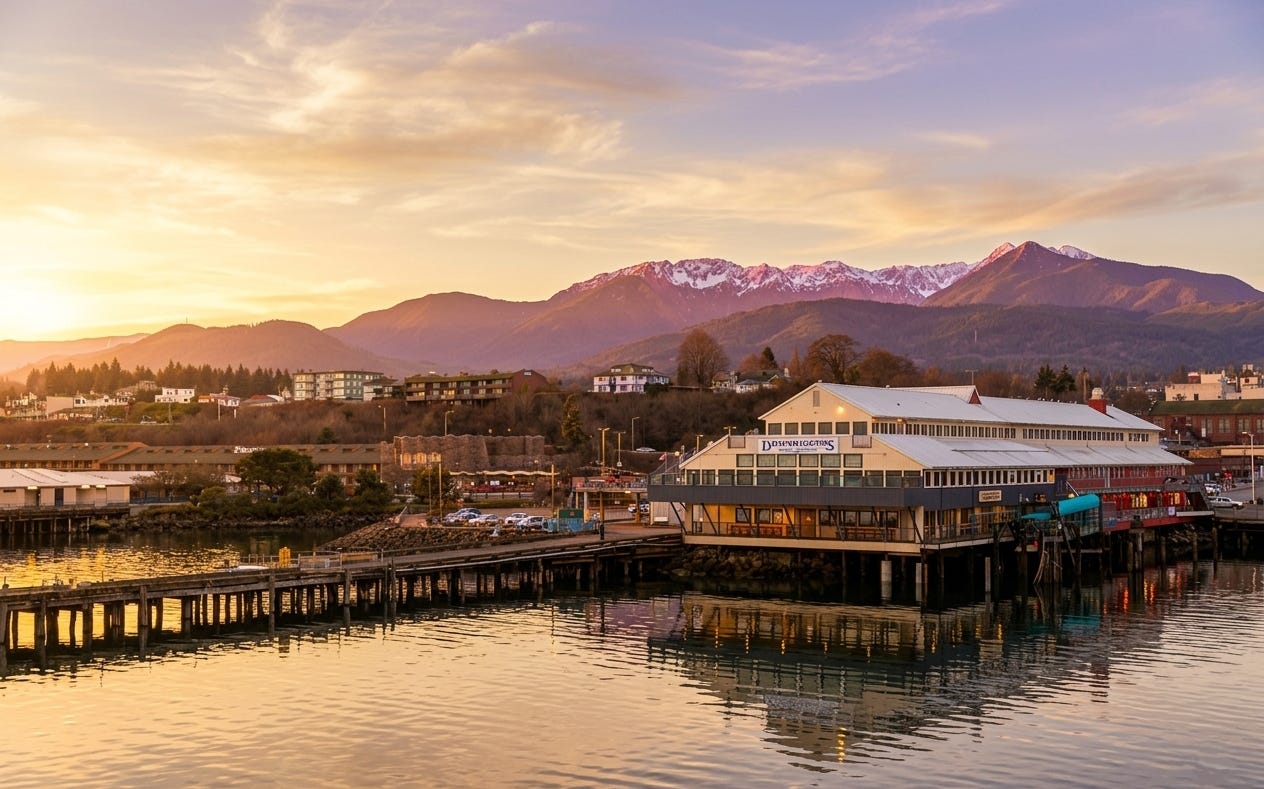
The thread got thin. For decades, it made sense to plug Clallam County into the global machine. Goods got cheaper. Credit got easier. The arrangement felt like progress.
What it actually was: every community on the Peninsula became a node at the end of a very long thread. Timber went to commodity markets. Fish got frozen and shipped to processing facilities hundreds of miles away. The hardware on the shelf at the local store came from a container ship in Seattle that came from a factory that came from a trade agreement negotiated by people who have never seen the Strait of Juan de Fuca. The arrangement worked as long as the thread held.
The thread is now more frayed than we think.
Several things are happening at once, and they are not unrelated. At the federal level, the orientation of American policy is shifting inward and hemispheric—away from the elaborate global trade architecture that has governed the last forty years and toward something older, more regional, more focused on this continent. Whatever you think of the politics, the structural effect is the same: the long supply chains that Clallam County plugged may get shorter, whether we planned for that or not.
Closer to home, Olympia has made commitments it cannot pay for. The obligations are real, the tax base to fulfill them is not, and the pressure to close that gap through taxation is already landing on people and businesses that don’t have much left to give. That story doesn’t end cleanly. It ends with the state doing less, administering less, delivering less—not because anyone decided that was the right outcome, but because the math wins eventually. That’s not doomer. Humans and their relationships are more adaptable than any system we build. Communities on this Peninsula have survived timber crashes, fishing collapses, and isolation that would have finished off places with less resourcefulness. The ship doesn’t sink. But the ship does change course, and the communities that have already started rowing under their own power will be better off than the ones still waiting for instructions from the wheelhouse.
Which means the work starts now. Not in reaction to a crisis. Not along partisan lines. There are no Republican salmon and no Democratic Doug-fir, but through the kinds of practical, local relationships that actually get things done, face to face: between farmers and foresters, tribal governments and county commissioners, fishermen and the clinics that serve their families. The administrative capacity that may not come from Olympia can be built here, in pieces, if we start before we need it rather than after.
This isn’t a political observation. It’s a structural one. Systems built on long, thin threads of dependency don’t wind down gracefully when the pressure increases. They snap. The Roman Empire didn’t gradually shrink back to Rome. It administered provinces, then it didn’t. The Soviet Union had offices on Monday and was effectively history by Thursday. The snapping doesn’t announce itself. It just happens, and then people look back and realize the fragility had been accumulating for years.
This County is a Cultural Ecology
Clallam County is a collection of distinct communities with different geographies, different histories, and different knowledge; and that variety, which sometimes feels like a weakness, is one of our relational strengths.
Neah Bay sits at the farthest tip of the Peninsula with an unbroken relationship to the sea. The Makah have been reading those waters. They know the currents, the salmon runs, the whale behavior, the seasonal rhythms of the Strait in ways that don’t appear in any database but are extraordinarily precise. That kind of deep, place-specific knowledge doesn’t just have cultural value, it has operational value. It tells you what to do and when to do it without waiting for instructions from outside.
Clallam Bay and Sekiu know what happens when an industry leaves town and doesn't come back: and they know it more than once. The tanning extract industry collapsed in 1893. The mills burned or closed. Logging came in, and logging's major industrial footprint eventually wound down too. The people who stayed through each of those contractions had to find a different way to keep going: fishing, hunting, small tourism, plain stubbornness. Maintaining community through repeated economic disruption, without waiting for someone outside to fix it is exactly the kind of knowledge that becomes essential when the global system gets unreliable. It's real deep knowledge, and it's earned.
Port Angeles sits on one of the most strategically positioned deep-water harbors on the West Coast: the first full port ships reach when they enter the Strait of Juan de Fuca from the Pacific. Depth enough for ocean-going vessels. The infrastructure is real. What’s missing is the industrial economy that once filled it. The mills that lined that harbor for decades are mostly gone. What remains is a port that could handle far more than it does, sitting in a county that imports most of what it consumes. That gap, between what the harbor could do and what it currently does, is a blank slate. Not nostalgia. But serious investment in what could be built around a deep-water port that most counties would give a great deal to have: marine trades, fishing infrastructure, expanded tourism.
Sequim has a rain shadow. In a county that receives more annual rainfall than almost anywhere in the contiguous United States, Sequim gets about seventeen inches a year. Combined with the Dungeness watershed, that makes it genuinely capable of producing food for the Peninsula most people haven’t seriously considered. Right now that capacity is treated as a pleasant feature of a retirement community. It should be treated as a local strategic asset.
Forks is deep in the trees and shaped by the full force of whatever the timber market does on any given year. The people there have long known what it means to have their livelihood decided in a boardroom somewhere far away: Vancouver, B.C., Olympia, or some other a federal land management office. Production mills west of Port Angeles have evaporated and one of the reasons was that raw logs were leaving the Peninsula on ships bound for Asian mills while the local mills closed for lack of fiber. That's not a market outcome. That's a policy failure. The next step is genuine local stewardship of the resources that surround that community, rather than just employment in an industry owned and managed elsewhere.
Olympic National Park is a genuine asset: a million acres, 2,500 visitors a day at Hurricane Ridge on a summer afternoon. The county’s economy knows it even when the county doesn’t say so. But the Hurricane Ridge Day Lodge burned down in 2023 during a renovation, and three years later there’s a design contract and not much else. Roads close and stay closed. The park is managed from afar or by people with little relationship to this place, yet the park was established because people here fought for it. That instinct is still worth something. What’s needed now is a seat at the table, not a hand out: local voices, tribal and county both, shaping how this place gets managed rather than just absorbing whatever decisions come down from Washington administrators.
What the Long Supply Chain Took From Us
The global system didn’t just create dependency on outside goods. It quietly replaced a lot of local knowledge with outside process.
When you can get anything from anywhere, you stop learning to make things close to home. When every problem gets referred to a state agency or a federal program or a corporate supply chain, local communities lose the habit—and eventually the capacity—of solving problems themselves. This happens slowly, almost invisibly. A cannery closes. A local mill shuts down. A clinic consolidates into a regional health system forty miles away. A school loses its shop program. Each individual change makes a certain kind of economic sense. The cumulative effect is a community that has traded depth of local capacity for access to distant systems it doesn’t control.
The Makah didn’t lose that depth. The fishing families in Sekiu didn’t entirely lose it. The farmers who work the Dungeness haven’t lost it. But in general, the Peninsula has become thinner in local knowledge and thicker in outside dependency, and that ratio is now working against us.
What Resilience Actually Looks Like Here
Resilience isn’t prepping, nor nostalgia. It’s building the kind of redundancy and deep knowledge that lets a community absorb a shock without collapsing.
In practical terms for this county, that means several things.
It means taking local food production seriously enough to fund it, zone for it, and organize markets around it, and not just convert it to high-tax luxury homes and property. The Dungeness Valley can feed far more of this Peninsula than it currently does. What’s missing isn’t land or water or knowledge: it’s the local economic infrastructure to make it worth doing.
It means treating the marine economy as something to protect and deepen rather than simply regulate. The fishermen working out of Neah Bay, Sekiu, and Port Angeles carry knowledge about these waters that took generations to accumulate. Policy that ignores or undermines that knowledge in favor of distant management frameworks is trading a genuine asset for an administrative convenience.
It means that local governance—from the county commission to tribal councils to city halls—needs to start asking a different question about every major decision: does this increase our capacity to manage our own affairs, or does it increase our dependence on something we don’t control? That’s not anti-government. It’s a survival question under de-globalization.
It means Port Angeles, Sequim, Forks, Neah Bay, Clallam Bay, and Sekiu cannot treat themselves as separate competitors for a shrinking share of outside resources. The Peninsula is a single ecology. If the ferry stops, it affects everyone. When the highway washes out, it affects everyone. If roads are closed into the Park, it affects everyone. Lose the forest, or lose access to it, and everyone here suffers. The communities that have survived the most difficult moments in this county’s history did it by helping each other.
The Honest Version
This transition has friction. Some things will cost more, some cost less. Some outside relationships the county depends on will become less reliable before local alternatives are strong enough to replace them.
But the alternative—continuing to deepen our dependence on a global system that is visibly becoming less stable—is not the safe choice. It just feels like the safe choice because it’s familiar.
All of it—the port, the forest, the watershed, the fishery, the park, the families—depends on something that no policy document can manufacture, global or local. It depends on people who know each other. The Makah fisherman and the Sequim farmer and the Forks logger and the Port Angeles harbor worker and the Clallam Bay family that has simply stayed, they carry between them a kind of distributed knowledge that only exists when it is shared face to face, across a table, over years. That knowledge does not survive in databases or Zoom calls or county meeting minutes. It survives in the specific gravity of looking someone in the eye and knowing what they know and what they've been through.
That knowledge is not a relic. It is not charming local flavor. It is a blueprint.
This county's real resilience has always lived here, in that living space between people. The work now is to tend it deliberately: to show up, to stay, to build the kinds of relationships that hold when everything else gets unreliable. That is not soft. It is the foundation everything else rests on.
Zelenka, D. (2026). Fabric–OpGeom Sociopolitical Dynamics: Attractor Setting as Constitutional Design. Preprint framework, v1.0. GitHub: github.com/davezelenka/threading-dynamics/blob/main/socio-political/fabric_opgeom_sociopolitical_v1.0.json
A global system that has never had to pay user and impact fees, with a bunker fuel base that pollutes more than any local industry ever did...and the jet stream makes sure we breath it,
The ship didn't sink but the "wheelhouse" clear cut forests and exported logs to pay for schools and hospitals that were so top heavy the ladder on the firetruck broke...then they went broke.. Globalism as you say was way more than getting stuff from around the world. It was also the start of Communist and Socialist infiltration, posing as environmental arms for the planet, when actually they only cared about making sure globalism didn't get any local competition.
Building 5 layers of bureaucracy, losing the local brick and mortar (JC Penny/Sears/Office Depot) did sink the ship, they just took out dissent and hid background screens so the public would not see the water was above the waterline.
Its been 35 years since Globalism was planted here, when the United Nations decided this Western corridor would by designated as "little to no human use." Since then the "Ship" has been tribes that could pull money out of water, and college grads with high paying government jobs, mostly from out of the area.
The ladder on the firetruck was already overloaded, they were just in denial. Then Amazon came in and took out local brick and mortar. Not long after we had water coming in and the main hatchway gave in, we just didn't want to admit we were on the Edmund Fitzgerald and we didn't want to say fella's its been good to know ya.